
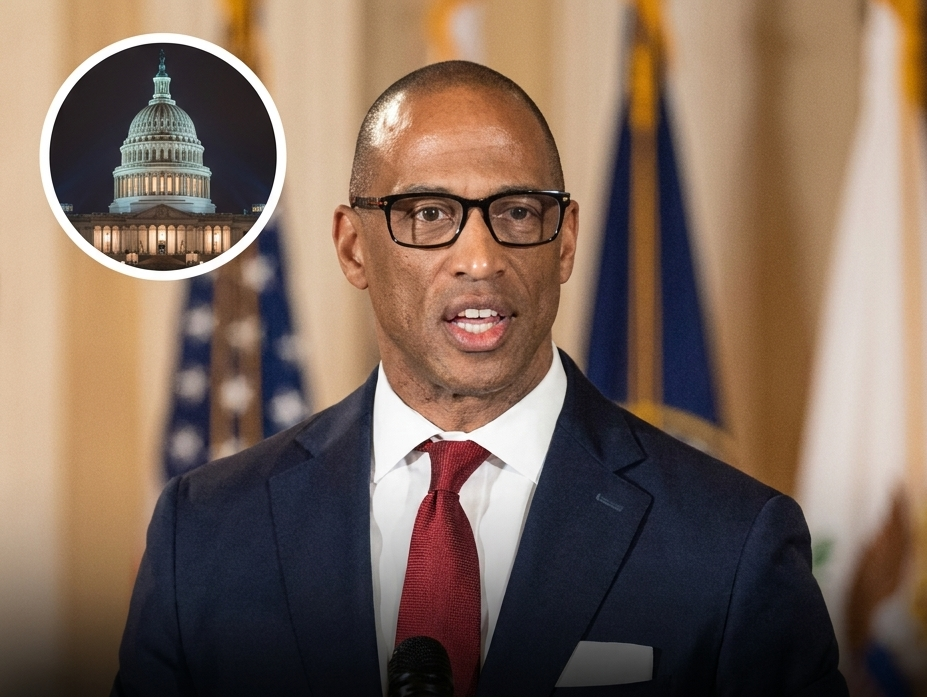
At the 75th annual National Day of Prayer event at the U.S. Capitol on Thursday, Housing and Urban Development Secretary Scott Turner declared that “God is the cornerstone of our Republic,” placing prayer, providence, and America’s founding squarely at the center of the gathering.
Turner, a former NFL player, pastor, and Cabinet secretary, spoke before lawmakers and faith leaders in an event marked by biblical language and appeals for national renewal. He framed the moment as both personal and national, linking his own path to public office with the broader story of the country’s religious heritage.
“Prayer is very powerful because Almighty God is powerful,” Turner told the audience. “That truth has guided our great nation through mountaintops and valleys for the past 250 years.” He then tied the nation’s founding to biblical conviction, describing the founders as men of faith who understood that God stands at the base of the republic’s moral order.
The event took place as Christians across the country gathered for the annual observance, which Congress established in 1952. President Harry S. Truman signed the law, and since then the first Thursday of May has carried a distinct place in the civic calendar for prayer, repentance, and intercession for the nation. This year’s theme drew from 1 Chronicles 16:24, with a call to tell of God’s glory among the nations and His deeds among all the peoples.
That framing gave the Capitol event a clear religious center. The emphasis was not on public ceremony alone, but on the conviction that national life still depends on divine mercy. For many Christians, that idea resonates deeply with the Book of Proverbs statement that, “The heart of man plans his way, but the Lord establishes his steps” (Proverbs 16:9, ESV).
Prayer In The Capitol
House Speaker Mike Johnson joined Turner at the event and reinforced the theme of God-given rights and inherited responsibility. Johnson urged believers to pass along what he described as the baton of faith and freedom to the next generation, framing liberty not as a political prize but as a moral trust.
The speaker’s remarks landed in a setting heavy with symbolism. The Capitol has long served as a stage for national debate, but on this day it became a place for prayerful reflection on the country’s origins and future. The gathering brought together government officials and Christian leaders around a message that blended civic duty with spiritual urgency.
Turner’s words also echoed a wider Christian conviction that prayer is not a ceremonial add-on but a real act of dependence. In the language of the event, prayer was presented as a force that has carried the nation through crisis and change. That matters in a country where faith often enters public life through the language of freedom, gratitude, and accountability before God.
The National Day of Prayer has always lived at that intersection. It belongs to the civic realm, yet it draws its force from a distinctly Christian understanding of authority, providence, and national purpose. At its best, the observance reflects an old biblical instinct: that leaders and citizens alike stand under God’s rule.
Turner’s Personal Testimony And Public Role
Turner brought more than policy credentials to the microphone. He brought a story of unlikely ascent, one that has repeatedly shaped how he speaks about vocation and calling. A former National Football League player, he later became an associate pastor at Prestonwood Baptist Church in Plano, Texas, before entering the Cabinet.
His confirmation as HUD secretary came by a 55-44 Senate vote, placing him in charge of a major federal department that oversees housing and urban development across 16 agencies and programs. Yet Turner has not spoken like a technocrat content to define leadership by bureaucracy alone. He has described his role in providential terms, treating public service as a calling rather than a career endpoint.
At a recent appearance at CPAC, Turner said he believed God had been preparing him “from before the womb” for his present work. In the Capitol setting, that same outlook came through again. He described himself as “unapologetic” and “unashamed” about God’s role in his life, presenting his personal journey as a witness to divine ordering rather than human ambition.
His background as a former dishwasher, professional athlete, and pastor has made him an unusual figure in national politics. But his presence at the National Day of Prayer fit the event’s long history of drawing leaders who speak the language of faith in public office. For Christian observers, the combination of pastoral identity and Cabinet authority added weight to his remarks.
Faith, Freedom, And The Founding
Turner’s central claim was direct: God is the cornerstone of the republic. He anchored that statement in the conviction that America’s rights come from God rather than government, a theme that has echoed through many Christian civic moments. Johnson’s remarks reinforced that same idea, putting theological language alongside constitutional memory.
That connection between faith and freedom is more than historical nostalgia. It remains a live issue for churches that wrestle with how to speak about the nation without confusing patriotism with worship. The Capitol event did not erase that tension, but it did show how many believers still understand civic life through a biblical lens.
The call to proclaim God’s deeds also pointed toward the wider mission of the church. The verse that framed the observance, from 1 Chronicles 16, comes from a song of thanksgiving and public witness. Its emphasis on declaring God’s glory among the nations gave the gathering a missionary edge, reminding Christians that prayer is meant to overflow into testimony.
For many denominations, that is no small thing. A day of prayer for the nation naturally invites questions about repentance, justice, wisdom, and mercy. It also asks whether public leaders, like all other people, can govern well without acknowledging the source of their authority. Scripture leaves little room for self-made power, even when nations imagine otherwise.
What The Event Signals Now
The 75th National Day of Prayer arrived at a time when American faith life still shapes public culture, even as religious affiliation shifts and civic confidence feels fragile. Against that backdrop, the Capitol gathering served as both affirmation and appeal. It affirmed that Christian language still has a place in national moments, and it appealed for renewed dependence on God.
Turner has also continued to emphasize practical policy with local impact, including efforts tied to economic development and community investment. His earlier work with Opportunity Zones drew more than $50 billion in private investment, a point that reflects his interest in helping neglected communities through market-based solutions. Even there, he has consistently framed policy in moral terms, linking opportunity to dignity.
That blend of public service and Christian conviction gave the prayer event an especially vivid tone. It was not a speech about abstract spirituality. It was a declaration made in the heart of American government by a man who openly ties his role to God’s providence and to the Christian story of calling, stewardship, and responsibility.
As the observance closed, the message remained clear: the nation’s future will not be secured by power alone, but by hearts turned toward the God Christians believe orders steps, hears prayer, and still shapes the course of history.