
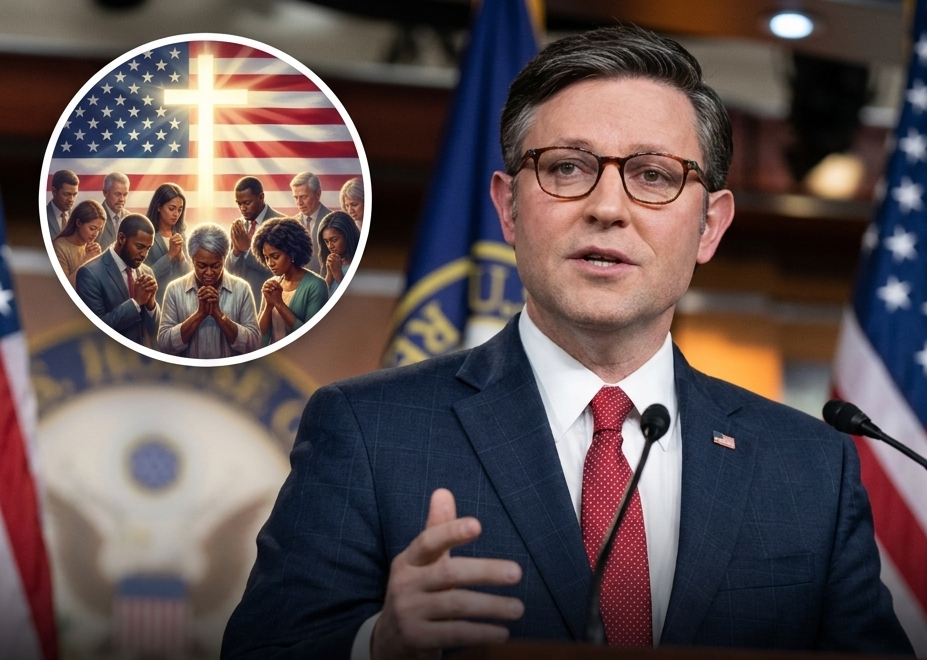
House Speaker Mike Johnson opened the 75th National Day of Prayer on Thursday at the U.S. Capitol with a blunt message: America remains, at its core, a praying nation. Speaking in Statuary Hall in Washington, D.C., Johnson told lawmakers, faith leaders, and invited guests that prayer has shaped the country from the beginning and still anchors its future.
The moment carried more than ceremonial weight. It came from one of the most visible Christian leaders in Washington, inside a hall lined with statues and artwork tied to the nation’s story, during the 75th annual observance of a day Congress first formally designated in 1952. Johnson’s remarks tied national memory, civic identity, and biblical faith together in a way that felt both historic and unmistakably current.
A Capitol Address Rooted In Prayer
Johnson framed prayer not as a private religious habit, but as a public source of strength that has followed America through war, expansion, sacrifice, and national crisis. He pointed to early colonial faith, the prayers of the Founding era, and the devotion of pioneers who carried belief westward as the nation grew. In his view, prayer has never been separate from the American story.
That message landed in a setting full of symbolism. Statuary Hall serves as one of the Capitol’s most recognizable chambers, and it has long been a place where national memory meets political power. On Thursday, it became a stage for a direct reminder that American civic life has always been intertwined with religious conviction, whether modern Washington wants to acknowledge it or not.
Johnson also connected prayer to the limits of government. He affirmed that rights do not originate in the state but in God, echoing the language of the Declaration of Independence and the broader American tradition that sees liberty as a gift rather than a government grant. The point was theological, but it was also civilizational. It reached back to the nation’s founding claims about human dignity and ordered freedom.
History, Scripture, And The Nation’s Memory
The 2026 observance carried the theme, “Glorify God Among the Nations, Seeking Him in All Generations,” drawn from 1 Chronicles 16:24. That passage comes from David’s thanksgiving after the Ark of the Covenant returned to Jerusalem, a moment marked by public praise and national reverence. The choice of theme gave the event a distinctly biblical frame and a reminder that public thanksgiving is not a modern invention.
Johnson’s emphasis on prayer as a source of strength fit naturally beside that theme. He described prayer as the place where the impossible happens and as the refuge that steadies people through storms. That language resonates across Christian traditions, from evangelical and Pentecostal prayer culture to Catholic and Orthodox practices of liturgy and intercession, and to mainline traditions that still hold prayer as the Church’s first act of dependence.
The speaker also used the occasion to look ahead to the United States’ 250th anniversary. He called for gratitude for divine provision and deliverance across the nation’s history and urged Americans to pass along faith and freedom to the next generation. The phrase had a civic ring, but it also carried a discipleship burden: every generation must decide what it will preserve, what it will forget, and what it will hand on.
The National Day Of Prayer At 75
This year marked the 75th anniversary of the National Day of Prayer as a congressionally recognized observance, though the country’s public days of prayer reach much farther back. President John Adams called for national humiliation, fasting, and prayer in 1798, and presidents across the centuries have returned to similar calls during war, unrest, and uncertainty. The 1952 law simply gave that older instinct a formal place in federal practice.
That long history matters because the observance has never been only about ceremony. It has reflected a recurring belief that national life requires moral accounting before God. In that sense, the anniversary in Statuary Hall was more than a commemorative event. It signaled that, even in a deeply polarized and secular age, prayer still has political visibility in the nation’s capital.
Scott Turner, the Housing and Urban Development secretary, also took part in the gathering and reinforced the same conviction about prayer’s power and God’s place in the nation’s founding story. His presence added to the sense that the event was meant to speak not only to churches but to the machinery of government itself. The message from the dais was consistent: America’s future cannot be secured by policy alone.
Faith In Public Life Still Has Weight
Johnson’s words arrived at a moment when many Americans, including many Christians, are asking whether public faith still belongs in civic life. The answer from Thursday’s observance was clear. In the Capitol, prayer was not treated as a relic, a private comfort, or a cultural accessory. It was presented as part of the nation’s operating logic.
For believers, that claim is familiar. Scripture repeatedly describes nations and rulers as accountable to God, not autonomous from him. Proverbs 14:34 — “Righteousness exalts a nation, but sin is a reproach to any people” — has long served as a touchstone for Christians who believe public life should be measured by moral truth, not merely power. Johnson’s remarks fit that worldview without sounding detached from the American civic tradition.
At the same time, the event reflected the broad, interdenominational nature of the National Day of Prayer itself. Catholics, Protestants, Orthodox Christians, and many independent churches have all used the day as an opportunity to pray for leaders, communities, schools, families, and national repentance. The language may differ from tradition to tradition, but the underlying conviction remains the same: God hears prayer, and nations are not beyond his care.
A Statement About Freedom And Responsibility
Johnson’s framing of the Declaration of Independence as a “national statement of faith” captured the larger mood of the event. The founding generation did not claim that government was the source of liberty. It claimed instead that certain truths were self-evident and that human rights existed before the state had any authority to recognize them. That idea remains one of the most contested and consequential in American history.
During a seasonal moment leading up to the nation’s 250th anniversary this summer, the speaker’s message placed that founding conviction back at the center of public conversation. Prayer, in his telling, is not merely about comfort in times of trouble. It is also about humility, memory, gratitude, and stewardship. And that matters.
For churches, the significance may be less about any single political speech and more about the public reminder that faith still shapes national language. In an era when religion is often treated as something to keep out of civic discourse, the Capitol event suggested a different possibility: that public prayer can still speak with clarity about where freedom comes from and what kind of people are needed to preserve it.
As the nation moves toward its semiquincentennial, Thursday’s gathering left behind a simple but searching note: a country that forgets how to pray may also forget what it was built to protect, but one that remembers may still find room for renewal.