
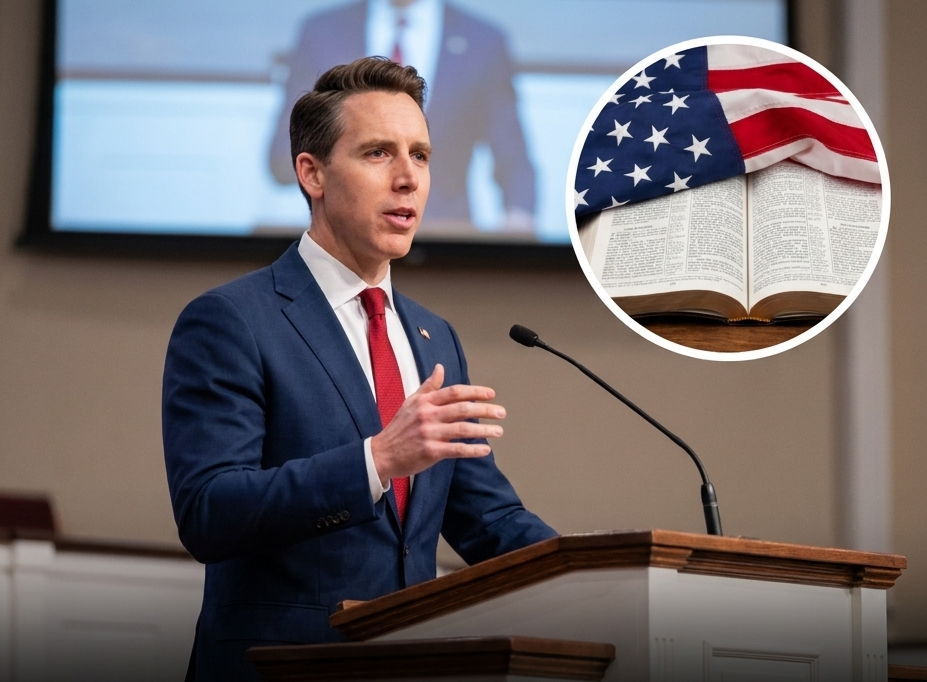
Sen. Josh Hawley set off a national argument this week after declaring that America was founded on “the Gospel of Jesus Christ,” a claim he tied to a broader call for spiritual renewal and public faith in the United States. The Missouri Republican made the remarks at a Kingdom Come Conference, where he urged a return to what he described as the nation’s Christian foundations.
That single line landed hard because it touched a live wire in American public life: the relationship between Christianity, civic identity, and constitutional government. Hawley cast the country not as a neutral experiment built on secular liberalism, but as a nation with a distinctly Christian inheritance that needs to be reclaimed.
Hawley’s Argument On America’s Origins
Hawley’s remarks went beyond a general nod to religion in public life. He framed the founding itself as rooted in a covenantal vision, arguing that the nation predates the Constitution with moral and spiritual obligations already in place. In his telling, the United States was meant to be “a place where the Lord is honored, where the Lord is worshipped, where the Lord is proclaimed.”
He described that vision as the “godly commonwealth” of the nation’s early forebears, placing the language of Christian purpose at the center of American identity. The statement has resonated with believers who see the country’s history as deeply shaped by Scripture, colonial covenant theology, and the moral assumptions of the churches that influenced public life from the beginning.
At the same time, the claim drew immediate pushback from those who view the founding through a different lens. For many Americans, the First Amendment and the broader constitutional order represent a deliberate effort to prevent the establishment of a national church. The debate is older than the republic itself, but it rarely disappears for long.
A Long-Running Debate Returns
Hawley’s comments reopened a familiar tension in American civic debate: whether the nation’s heritage is best described as Christian, broadly religious, or intentionally secular in structure. Supporters of his view often point to the religious language of the founders, the prevalence of Christian practice in early American communities, and the enduring public influence of the Bible on law, education, and moral culture.
Critics, however, argue that appeals to a Christian national identity can flatten the complexity of the founding era. They note that religious liberty protections were crafted in part to protect conscience across denominations and to prevent state coercion in matters of worship. That debate remains especially sensitive in a country where Christians themselves span a wide range of convictions about church and state.
It is worth pausing on that. The United States has long held together competing instincts: public reverence toward God on one hand, and legal protections against established religion on the other. Hawley’s remarks landed directly in that tension, which helps explain why they stirred such strong reactions so quickly.
From Speech To Legislation
The senator did not leave the issue at the level of rhetoric. He has also promoted the In God We Trust Act, legislation that would require the national motto to be displayed on all federal buildings. The proposal fits neatly with his broader message that the nation should visibly acknowledge God rather than treat faith as a private matter alone.
That legislative push overlaps with President Trump’s “America Prays” initiative, which has encouraged public expressions of faith tied to national life. Together, those efforts reflect a wider movement among some conservative Christians and allied lawmakers to restore religious language and symbols to a more prominent place in public institutions.
For churches that have watched faith recede from public square visibility, the momentum feels significant. For others, the question is whether a stronger public role for religion strengthens Christian witness or risks tying the gospel too closely to state power. The distinction matters, particularly for denominations that have long warned against confusing the mission of the Church with the interests of the government.
Religious Liberty And Church Concerns
Hawley’s remarks also fit into his broader advocacy on religious liberty. He has pushed for investigations into alleged anti-Christian violence and past federal targeting of Christians, presenting himself as a defender of believers who believe they have faced unequal scrutiny or hostility in recent years.
That message has found support among Christians who see signs of increasing pressure on public faith, especially in workplaces, schools, and federal agencies. For many believers, the concern is not simply symbolic recognition, but whether Christians will be allowed to live openly and faithfully without penalty.
At the same time, the language of national Christianity can sound different to different ears inside the Church. Some evangelicals welcome it as a corrective to secular drift. Catholic, Orthodox, and mainline Protestant voices often approach such claims with more caution, preferring strong religious freedom protections without endorsing a single civil religious identity. And that matters, because the Christian public square has never spoken with one voice.
Why The Moment Struck A Nerve
The intensity of the reaction says as much about the current cultural climate as it does about Hawley himself. America’s “spiritual crisis,” as he described it, has become a common theme in conservative Christian circles, where rising secularism, family instability, and declining church attendance are often read as connected symptoms.
Hawley’s remarks tapped into that anxiety and gave it a national frame. He presented the country’s troubles not only as political or economic failures but as evidence of spiritual dislocation, a diagnosis that resonates deeply with readers of Scripture who see national flourishing linked to moral order and reverence for God.
Many Christians will hear echoes of passages like Proverbs 14:34, which in the ESV says, “Righteousness exalts a nation, but sin is a reproach to any people.” Others will respond more cautiously, noting that the New Testament does not promise earthly nations covenant status in the same way it speaks of God’s people. Both instincts are present in the Christian tradition, and both shape the way believers read public events like this one.
A Familiar Question, A Fresh Flashpoint
Hawley’s statement did not emerge in a vacuum. It arrived amid a broader resurgence of debates over Christian nationalism, public prayer, school religion disputes, and the place of biblical language in national politics. Each of those conversations carries its own history, but together they have made religion a major fault line in American cultural life again.
That is no small thing for churches watching it unfold. When a sitting senator argues that the nation was founded on the gospel, he is not only making a historical claim. He is also shaping the way millions of people think about citizenship, worship, and the Church’s role in public life.
For now, Hawley’s remarks have succeeded in doing what charged political-religious language often does: they have clarified loyalties, sharpened disagreements, and reopened old questions about whether America’s future depends on a return to Christian conviction or on a renewed defense of pluralism. In either case, the debate is unlikely to fade soon, and the Church will keep asking what faithfulness looks like in the middle of it all.