
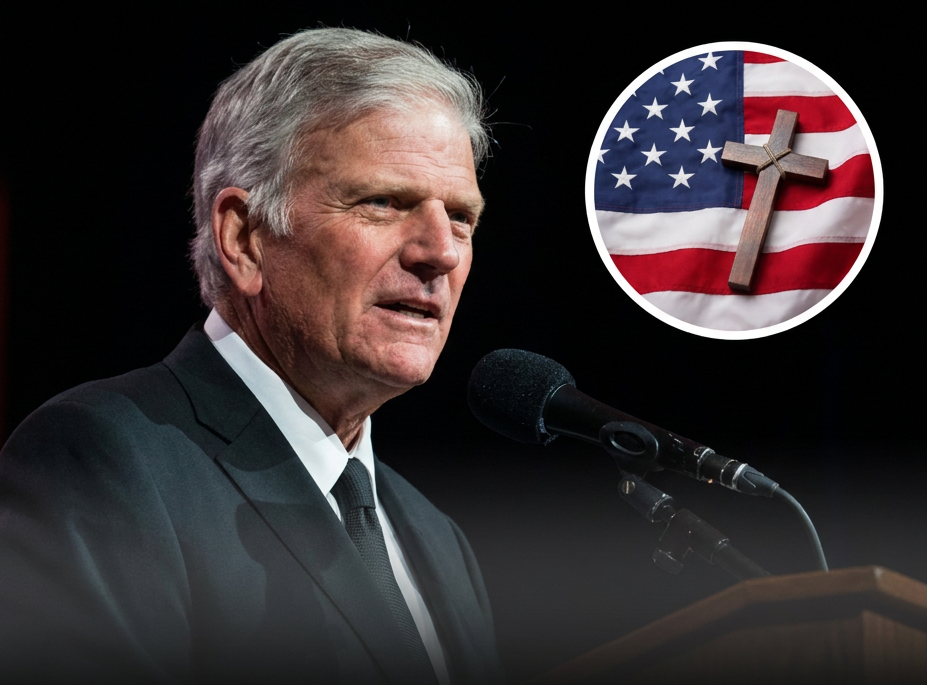
Evangelist Franklin Graham is pressing Christians to stay engaged in politics through prayer, repentance, and concern for national leaders, framing the moment as a spiritual crisis for the United States. In recent remarks and social media appeals, Graham has urged believers to stop, pray, and ask God for peace in the streets, restraint among leaders, and mercy for a nation he says has drifted from biblical truth.
The message comes amid continuing political volatility and civic unrest, and it reflects a familiar but sharpened theme in Graham’s public ministry: Christians should not retreat from public life. Graham is urging prayer as the first response, not the last resort, and he is casting that prayer as both personal and national in scope.
Prayer First, Not Withdrawal
Graham has repeatedly framed America’s challenges in spiritual terms, describing the nation as being in trouble and calling believers to pause for a time of prayer and repentance. The emphasis has not been on building a political movement, but on seeking divine intervention before any civic strategy takes shape.
That distinction matters. Graham’s appeal places prayer at the center of Christian civic engagement, rather than treating politics as the main engine of change. In his view, believers should remain attentive to elections, leaders, and policy debates, but they should do so with humility and moral seriousness.
His public calls have also stressed that national unrest cannot be handled by human effort alone. The language surrounding his message points to calm in the streets, guidance for those in authority, and a renewed willingness among Christians to live as peacemakers in a tense public square. That is no small thing in a country where faith and politics often collide more than they converse.
Repentance As A Public And Personal Matter
A central part of Graham’s appeal is repentance, and not merely in a generalized religious sense. His recent emphasis has included both national repentance and personal repentance, suggesting that the crisis facing the country begins in the heart before it reaches the ballot box or the legislature.
That mirrors a longstanding biblical pattern. In Scripture, moments of national distress often prompt calls to turn back to God, not simply to adjust policy. The language of repentance echoes passages such as 2 Chronicles 7:14, which speaks of humbling oneself, praying, seeking God’s face, and turning from wicked ways.
Graham has used that kind of moral urgency to argue that Christians should not grow numb to public decay. His message suggests that political disengagement can become a form of surrender, while faithful engagement requires prayerful discernment and a willingness to speak and act with conviction.
Leaders, Decisions, And The Weight Of Authority
Another consistent feature of Graham’s appeals has been prayer for presidents and other U.S. leaders. He has urged Christians to ask God for wisdom over critical decisions and for restraint in moments when national choices affect peace, order, and the future of the country.
That posture reflects a broad biblical concern for governing authorities. In 1 Timothy 2:1-2, believers are instructed to pray “for kings and all who are in high positions, that we may lead a peaceful and quiet life, godly and dignified in every way.” Graham’s language fits neatly within that framework, even as it carries a more urgent tone suited to the present moment.
His concern is not limited to one office or one party. The emphasis stretches across the whole structure of civic authority, from the presidency to other national and local leaders. Underneath it all is a warning that policy choices and public rhetoric can either steady a nation or deepen its instability.
A Call To Be In The Culture, Not Hidden From It
Alongside prayer, Graham has urged believers to vote responsibly and remain engaged in the issues shaping their communities and the nation. He has warned that some leaders and policies are moving further away from biblical values, and he has framed that drift as a reason for Christians to be more visible, not less.
In that sense, his message pushes against a quiet but real temptation inside the church: the idea that faith can stay safely private while public life unfolds elsewhere. Graham is arguing instead that Christians have a responsibility to be a light in culture, even when the culture feels hostile or disordered.
That view cuts across denominational lines in different ways, but it speaks to a common Christian conviction that faith touches public life. Catholics, evangelicals, Orthodox believers, and many Protestants would all recognize pieces of that call, even if they disagree on specific political conclusions. The deeper claim is simpler: discipleship does not end at the church door.
The Church’s Role In A Fractured Moment
Graham’s appeal also places a measure of responsibility on the church itself. He has asked believers to act as instruments of peace, a phrase that resonates with Jesus’ words in Matthew 5 about the peacemakers, “for they shall be called sons of God.”
That language is especially striking in a season when political identity often feels louder than Christian witness. Graham is effectively telling churches and individual believers that faithful public engagement should be marked by prayer, humility, and restraint rather than rage or despair.
It is worth pausing on that. In times of national division, the church can easily mirror the same urgency and outrage that animate the wider public. Graham’s call pushes in the opposite direction, insisting that Christians engage the moment without being mastered by it.
Why The Message Is Landing Now
The latest coverage around Graham’s remarks suggests the emphasis is on a coordinated prayer moment rather than a formal campaign or political endorsement. Even so, the timing gives the message added urgency, since many Americans continue to feel unease about polarization, unrest, and the direction of public life.
Graham’s warnings about a nation turning away from God are not new, but they land differently when matched with calls for calm streets, wise leadership, and corporate repentance. The result is a message that blends urgency with restraint, and civic concern with spiritual dependence.
For Christians watching the moment closely, the challenge is not simply whether to care about politics. It is how to care about politics without losing sight of prayer, repentance, and the call to be faithful in public without becoming captive to public anger.
For Franklin Graham, the answer is clear enough: stay engaged, pray deeply, vote responsibly, and ask God to make his people instruments of peace in a troubled country.