
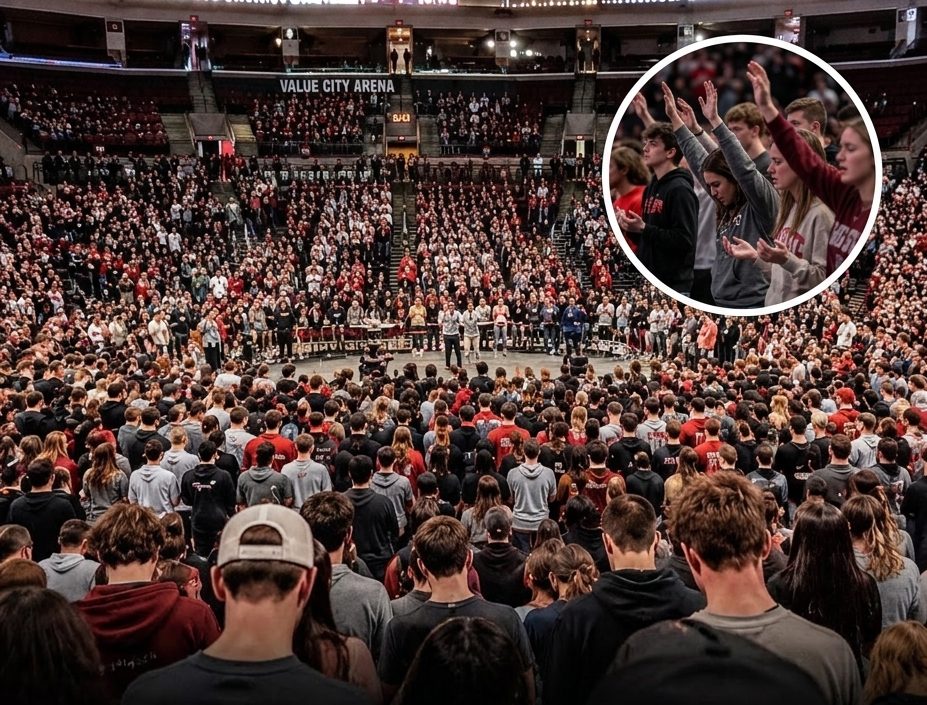
Nearly 2,000 students reportedly responded to a gospel invitation at Ohio State University in Columbus, Ohio, during a February worship gathering that drew more than 6,500 attendees to the Schottenstein Center. The one-night event, tied to the Unite US movement, centered on Jesus, prayer, testimonies, worship, and baptisms, and it has quickly become one of the most talked-about campus-faith gatherings of the year.
The most striking detail is not only the size of the crowd, but the reported response. In the middle of freezing weather, students filled one of the university’s largest indoor venues and then stayed engaged long after the singing ended, with baptisms reportedly taking place outside on the backs of U-Haul trucks because of the cold.
A Campus Night With A Clear Gospel Focus
The event at Ohio State was framed as more than a concert or a motivational rally. It was presented as a worship service centered on the Christian message, with students gathering for prayer, testimonies, and a direct invitation to follow Christ. The reported response of nearly 2,000 decisions turned the night into a major faith moment for a university better known nationally for athletics, academics, and Big Ten visibility.
The size of the crowd matters, but the spiritual emphasis matters more. For many campus ministries, large events can draw curiosity without lasting impact. This gathering appears to have moved beyond attendance numbers and into the language of conversion, baptism, and public expression of faith.
That distinction has helped the story spread quickly through Christian media circles. It also places Ohio State within a broader wave of student religious activity that has drawn attention on college campuses across the United States in recent years.
Cold Air, Warm Response
Weather added an unexpected layer of urgency to the night. Coverage described students braving freezing temperatures to take part in the gathering, including baptisms carried out outdoors in an improvised setting. Reports that baptisms took place on the backs of U-Haul trucks gave the event a raw, spontaneous character that has made the story especially memorable.
There is something deeply biblical about that picture. The New Testament does not present baptism as a polished production. It presents it as a public act of obedience, closely tied to repentance and new life in Christ, as seen in passages like Romans 6:4, where believers are said to be raised “to walk in newness of life.”
For many Christians watching the Ohio State story, the cold only sharpened the sense of seriousness. Students were not gathering for comfort. They were gathering for confession, worship, and a visible step of faith.
The Unite Us Connection
The Ohio State gathering was part of the Unite US movement, which has become one of the more recognizable names in the current wave of college ministry events. The movement has been linked to large student worship nights that combine contemporary music, evangelism, prayer, and opportunities for baptism and prayer response.
Unite US events have drawn attention because they seem to tap into a spiritual hunger that crosses denominational lines. Students from different church backgrounds, and some with little or no church history, appear to be showing up in large numbers. The pattern suggests that interest in Christian faith among young adults is not confined to one campus, one region, or one tradition.
At Ohio State, the reported response gave the movement one of its strongest headlines yet. Nearly 2,000 students making decisions to follow Christ in a single evening is the kind of figure that naturally draws scrutiny, hope, and questions about what happens next.
Why The Numbers Are Grabbing Attention
More than 6,500 students reportedly attended the event, a turnout large enough to fill a major arena and signal substantial interest. For campus ministries, that scale is significant in itself. But the reported number of decision responses is what has made the story travel far beyond Columbus.
Large campus gatherings have a history in American evangelical life, from student awakenings in earlier generations to modern revival meetings and worship events. What feels different now is the speed with which word spreads and the way student-led or student-attracting events can ripple across digital platforms in real time.
The Ohio State story cuts against the assumption that Gen Z is uniformly uninterested in faith. It suggests something more complicated and, for churches, more hopeful: that many students are still open to the gospel, especially when it is presented clearly and within a community that feels earnest rather than performative.
A Broader Pattern Across College Campuses
The Ohio State event has been placed alongside similar campus gatherings that have drawn strong attendance and visible spiritual response. Across the country, Christian ministries have reported renewed interest in worship nights, prayer meetings, baptisms, and evangelistic outreach among college students.
That emerging pattern has prompted careful optimism in many churches. Presbyterian, Baptist, Pentecostal, Catholic, Anglican, and independent ministries all have reason to pay attention when student gatherings begin producing spiritual fruit that looks less like novelty and more like lasting hunger.
Still, the church has long understood that dramatic moments are only the beginning of the story. In Scripture, crowds gather around Jesus often enough, yet discipleship remains the deeper call. The Ohio State event may be remembered for its size, but its real test will be whether local churches and campus ministries can help absorb, disciple, and nurture the students who responded.
What Comes After The Arena
At a university as large and influential as Ohio State, even a single night of this kind can have an outsized effect. Some students who responded will likely connect with local congregations. Others will begin exploring faith for the first time. A portion may be processing doubts, questions, or a moment of conviction they had not expected.
That is no small thing. Campus awakenings rarely remain confined to the place where they begin. They tend to move outward through friendships, residence halls, student groups, and churches that welcome new believers into ordinary Christian life.
For now, the Ohio State gathering stands as one of the clearest recent examples of a widely reported spiritual response among American college students, a night when worship, weather, and public baptism all converged around a single message: Jesus still calls, and many young adults are still answering.