
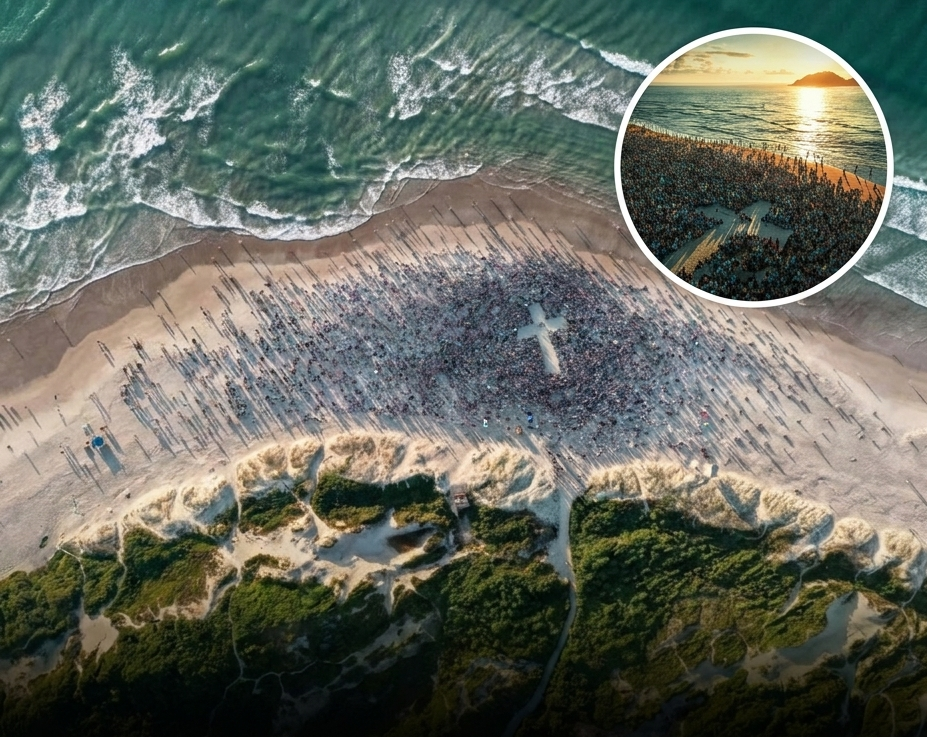
Thousands of Christians gathered on a Brazilian beach for a mass worship event that ended with public baptisms and a striking human cross formed along the shoreline. The scene unfolded amid growing reports of large-scale evangelical momentum across Brazil, especially in regions where public expressions of faith have become both visible and increasingly frequent.
The beach gathering brought together worship, prayer, and baptism in a single public display of Christian identity. Photographs and reporting from the event depict participants standing shoulder to shoulder in a cross-shaped formation, turning the shoreline into a vivid symbol of devotion to Jesus Christ.
Public Baptism Becomes A Visible Sign
The baptisms drew attention not only for their scale, but for their symbolic setting. Baptism has long marked a public confession of faith in Christian tradition, and the beach setting gave that confession an open, communal shape. The human cross added another layer, making the gathering as much a statement of identity as an act of worship.
That matters in Brazil, where evangelical Christianity has expanded steadily in recent years and where outdoor worship gatherings have become an increasingly familiar part of religious life. The beach event fit within that broader pattern, mixing celebration, testimony, and visual symbolism in a way that resonated far beyond the shoreline.
Recent Christian reporting has also highlighted a larger pattern of baptisms in Brazil’s Amazon region. In one ministry effort there, 14,500 people were baptized in the first six months of the year, with organizers setting a goal of more than 30,000 baptisms by year’s end. Those numbers point to an evangelistic effort that is moving through river communities and remote settlements with unusual speed.
Brazil’s Revivals Are Moving Beyond Cities
The Amazon work has drawn particular attention because it depends on canoe and small-boat travel to reach isolated communities. Pastors and missionaries have pushed deep into river regions, carrying the gospel to places that often sit far from traditional church centers. The result has been a wave of baptisms that gives shape to the larger story unfolding in Brazil.
The beach gathering appears to belong to that same current. It reflects a form of Christianity that is public, participatory, and unembarrassed about making its faith visible. In a country with a complex religious landscape, these events have become one way many believers express confidence that the gospel is still moving with power.
Brazil has long been home to some of the largest Christian gatherings in the world, from citywide crusades to spontaneous prayer meetings in public squares. But the recent emphasis on baptism, especially in large open-air settings, suggests something more than simple pageantry. It points to a church eager to connect evangelism, discipleship, and public witness in one setting.
The Human Cross And Its Message
The human cross formed at the beach gave the event its most memorable image. Cross imagery sits at the center of Christian faith, and in this case the participants turned their bodies into a collective sign of surrender, unity, and praise. The visual was bold, but its theological meaning was plain: Christ crucified remains the heart of Christian confession.
For many churches, especially in evangelical and Pentecostal settings, public symbols like this are not seen as performance but as proclamation. They communicate that faith belongs in ordinary life, not hidden away from view. The shoreline cross made that message easy to grasp at a glance.
Scripture gives the cross that same central place. Paul wrote in 1 Corinthians 1:18, “For the word of the cross is folly to those who are perishing, but to us who are being saved it is the power of God.” The Brazilian gathering seemed to embody that conviction in a way that was visible, communal, and unmistakable.
A Wider Evangelistic Push
The beach event did not emerge in isolation. It came at a time when reports from Brazil have increasingly focused on baptisms, outreach, and the expansion of Christian ministry into remote and underserved regions. Large gatherings and river-based evangelism together suggest a church that is working both in public spaces and far from them.
In the Amazon, the numbers have become difficult to ignore. Baptisms numbering in the tens of thousands suggest sustained ministry rather than a passing moment. They also reveal the patience required to travel, teach, and disciple across vast distances where access can be limited and logistical challenges run high.
For many Christians watching these developments, the significance lies not just in numbers but in momentum. Public baptisms have a way of signaling that faith is not merely surviving in a culture; it is spreading. And when those baptisms take place beside a beach or along a riverbank, the geography becomes part of the testimony.
Why The Scene Resonates Beyond Brazil
The image of thousands of believers gathered in worship has quickly traveled beyond Brazil’s borders because it touches a nerve common to Christians everywhere. It speaks to longing for renewal, hunger for unity, and the hope that spiritual life can still break into public view with force. In a fragmented age, a crowd formed around baptism and prayer carries its own quiet challenge.
The event also reflects a broader Christian instinct to mark faith in visible ways. Baptism has always stood at the threshold between private belief and public confession. When thousands gather to do it together, the act becomes communal evidence of a shared spiritual moment.
Across denominations, that witness carries weight. Some traditions emphasize the sacrament’s mystery, others its symbolic declaration, but all recognize its place as a defining act of obedience and identity. The Brazilian shoreline gathering placed that shared meaning at the center of the story.
For now, the beach event stands as one more vivid chapter in Brazil’s expanding wave of public Christian expression. If the broader ministry reports from the Amazon are any indication, the shoreline scene may be less an exception than a sign of what is still unfolding.
And for believers watching from afar, the image of a human cross stretching across the sand offers a simple, enduring reminder that the church is still built around the One who said, “If anyone would come after me, let him deny himself and take up his cross daily and follow me” (Luke 9:23).