
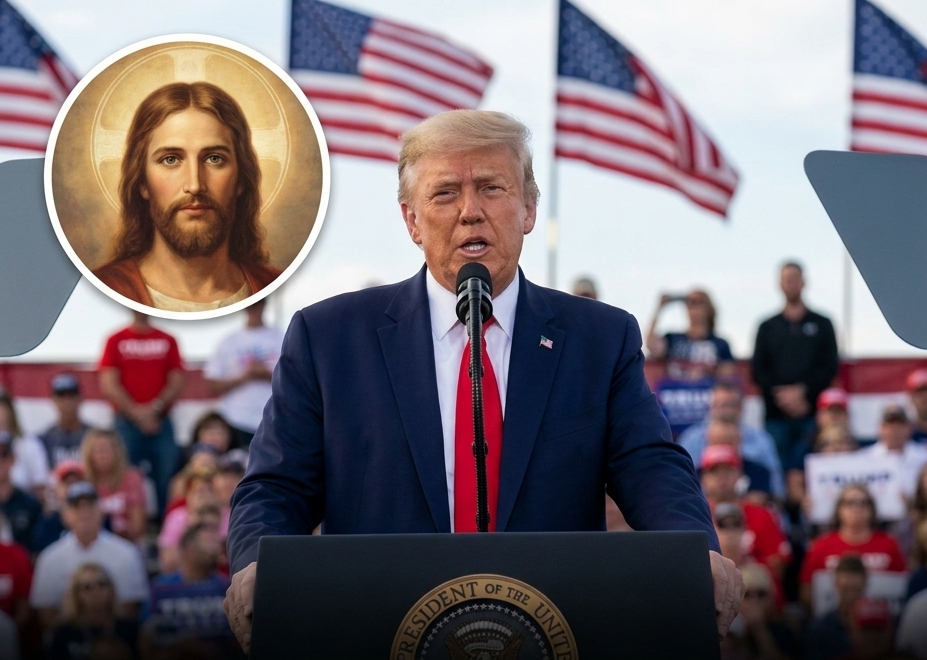
President Donald Trump marked Christmas with a forceful declaration that Jesus Christ brings “salvation for every person and every nation,” framing the nativity as the moment when “human history turned from night to day.” The message, delivered on Thursday evening, placed the birth of Christ at the center of America’s public faith conversation and drew immediate praise from supporters as well as sharp attention from critics.
Trump’s remarks reached beyond holiday sentiment. He tied the birth of Jesus to grace, truth, service, and the image of God in every child, calling Christianity a foundational force in the nation’s history and strength. In a season when political language often reaches for symbolism, this statement landed as a direct theological claim about the universal scope of salvation.
The Christmas Message And Its Reach
At the heart of Trump’s message was a familiar Christian theme: the Incarnation as good news for the whole world. He described Christ as bringing the gift of God’s love into the world and the promise of salvation for every person and every nation. That language echoed the broad sweep of passages such as John 1:14, where the Word becomes flesh, and Matthew 28:19, where the gospel is carried to the nations.
The message also linked faith to public virtue. Trump presented Christ’s words and example as a call to love, serve, and honor the dignity of others. That emphasis mattered because it placed Christian belief not only in the realm of private devotion but also in the moral imagination of a country that still argues over what role religion should play in public life.
For many Christians, the most striking part of the message was the language of universality. Salvation was not framed as tribal, national, or reserved for one political identity. It was presented as the good news of Jesus Christ for all peoples, a theme central to the New Testament and deeply familiar across Catholic, Protestant, and Orthodox traditions alike.
Faith, Politics, And Public Attention
The reaction was immediate. Supporters treated the statement as a bold affirmation of Christianity in a culture that often sidelines it. Critics, meanwhile, folded the message into larger arguments about Trump’s use of religious language and the politics of faith during an election season that continues to make Christianity a major talking point.
That tension has grown sharper as religion remains a prominent part of the 2026 political conversation. Trump has continued to present himself as a defender of Christian values and America’s religious roots, a posture that resonates strongly with many evangelical voters and with churchgoers who feel cultural change has pushed historic faith commitments to the margins.
His Christmas message fit neatly into that broader pattern. It presented the birth of Christ not as a vague holiday tradition, but as the decisive turning point of history. It also cast Christian faith as the “true source” of greatness, happiness, and strength, a claim that speaks to both theological conviction and national memory.
Franklin Graham’s Public Support
The Christmas statement came after another recent flashpoint involving Trump and Christian belief. Franklin Graham publicly affirmed Trump’s salvation in a personal letter that later appeared on Truth Social on Palm Sunday. The note addressed the matter of eternal life directly and tied Christian assurance to belief in Jesus Christ.
That intervention stood out because it pushed the subject of Trump’s spiritual standing into unusually direct territory. In public life, politicians often speak about faith in broad terms, but Graham’s letter treated salvation as a clear and urgent matter. For evangelical supporters, that kind of bluntness can feel like pastoral clarity rather than political theater.
The exchange also reflected a wider reality inside American Christianity. Believers across denominations often differ on politics, but they tend to agree that salvation is ultimately a matter of grace, not celebrity, office, or public reputation. That conviction has kept Trump’s faith claims under close scrutiny, even among some Christians who appreciate his defense of religious liberty.
Grace, Works, And The Gospel Debate
The discussion around Trump has also revived older theological questions about how salvation is understood. Some Christian observers have pointed to previous comments from Trump that appeared to connect heaven with personal accomplishments or moral performance. Those remarks have prompted concern because the New Testament repeatedly teaches that salvation is by grace through faith, not by works.
Ephesians 2:8–9 remains one of the clearest summaries of that doctrine: salvation is “by grace… through faith,” “not a result of works.” Galatians 2:16 presses the same point, declaring that a person is not justified by works of the law but through faith in Jesus Christ. For many Christians, those texts form the very backbone of the gospel.
Romans 3:20–26 adds another layer, teaching that righteousness comes through faith in Christ and his atoning blood. Titus 3:4–7 speaks of salvation as an act of divine mercy, not human merit. Those passages matter here because they show why the debate around Trump’s language is not a side issue. It goes to the center of Christian belief.
What The Message Means For Churches
Even so, the Christmas declaration has given many church leaders and believers an opening to talk about the meaning of Christ’s birth in a public square that often flattens it into sentiment alone. Trump’s emphasis on grace, truth, service, and the value of every child made in God’s image echoes teachings that churches across traditions already proclaim from pulpit and catechism.
It is worth pausing on that. In a country where Christianity still shapes millions of lives, a presidential message that talks openly about salvation and the nations can stir both genuine encouragement and serious discernment. That mixture is familiar to pastors, theologians, and lay believers who know that public declarations are never a substitute for personal faith, but they can still point attention toward Christ.
Some Christians will hear the message as a welcome reminder that the gospel is for the world, not merely for one nation or one political movement. Others will take a more cautious view, unwilling to let national language eclipse the New Testament’s insistence that the cross, not any government, is the place where hope is secured.
A Universal Invitation Still Stands
Trump’s Christmas declaration, Franklin Graham’s earlier affirmation, and the wider theological debate around them all return to one central Christian claim: salvation is found in Jesus Christ alone and offered to all who believe. John 10:28 speaks of Christ’s sheep hearing his voice and never being snatched from his hand, while 1 John 5:13 explains that believers can know they have eternal life.
Romans 10:11–13 widens the door even more, promising that everyone who calls on the name of the Lord will be saved. That is the enduring hope beneath the headlines, and it explains why these public moments keep drawing such strong responses from Christians across the spectrum.
As the Christmas season unfolds and the 2026 political conversation grows louder, Trump’s message has placed the claims of the nativity back in public view, where the Church continues to point not to a nation’s greatness but to the Savior whose birth still announces hope for the world.