
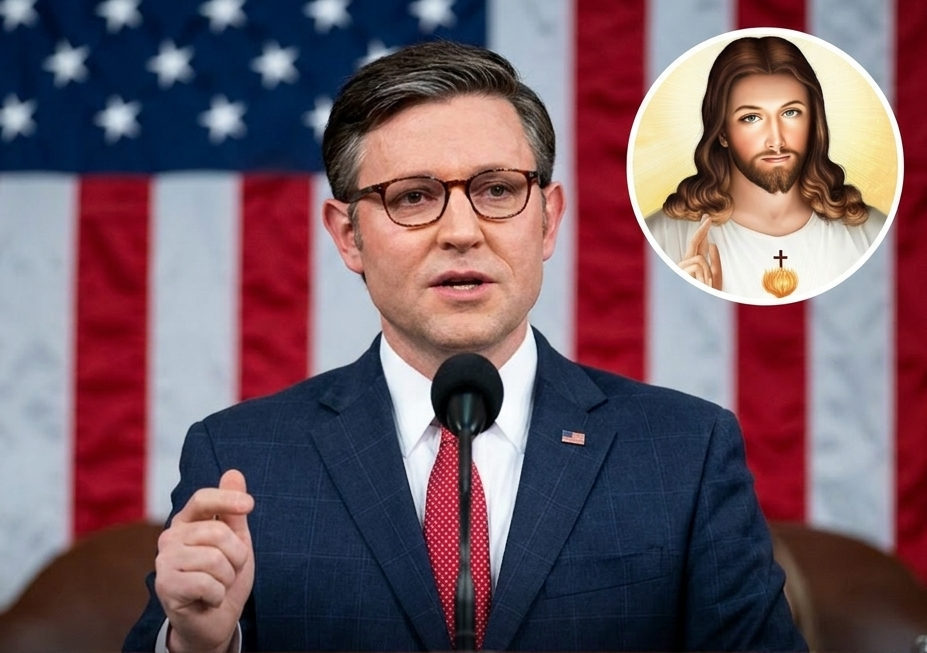
House Speaker Mike Johnson used this year’s National Day of Prayer observance at the Capitol to argue that prayer is not simply a private devotion, but a public lifeline for the nation. Speaking in Washington amid sharp political and cultural division, Johnson said, We know that prayer is where the impossible happens.
The remarks drew immediate attention from supporters who welcomed his message of faith and civic humility, and from critics who questioned the role of open religion in politics. Johnson, a Louisiana Republican known for his evangelical convictions, framed prayer as central to America’s past and essential to its future.
A National Day of Prayer message at the Capitol
Johnson led the National Day of Prayer observance at the Capitol, where he emphasized that prayer should be treated as a first response rather than a last resort. He pointed to Scripture’s repeated call for believers to pray continually and said the practice shapes moral clarity and public responsibility.
His remarks came during a moment of deep national strain, with ongoing debates over life, family, religious liberty, and the health of democratic institutions. Johnson presented prayer as a unifying discipline that can steady both citizens and leaders when the public square feels fractured.
He also urged Christians and other people of faith to gather in prayer vigils, fasting, and intercessory meetings. In his view, those practices are not ceremonial gestures but tools of spiritual renewal that can influence civic life in concrete ways.
For Johnson, the observance carried historical weight. He argued that prayer has been woven into American life since the founding era, shaping constitutional debates, wartime decisions, and moments of crisis across generations.
Prayer, history, and the Founders
Johnson’s speech reached beyond the present political moment and into a broader account of the nation’s spiritual heritage. He described prayer as part of the rhythm of American public life from the Founding Fathers to modern leaders, insisting that dependence on God has often accompanied the country’s most consequential decisions.
That framing reflects a familiar theme in Johnson’s public ministry as speaker. He has repeatedly used the National Day of Prayer as a platform to call the country to humility, repentance, and guidance before God, especially in times of uncertainty.
His message also drew on a biblical pattern. Johnson cited the early church, saying prayer preceded apostolic preaching, miracles, and the spread of the Gospel. In that telling, spiritual movements are born in prayer before they appear in public witness.
The reference to the early church gave the speech a distinctly Christian frame. It also connected Johnson’s civic appeal to a longstanding evangelical conviction that public renewal begins in private dependence on God, not merely in legislation or institutional reform.
A call to churches and civic leaders
Johnson encouraged churches and parachurch ministries to organize prayer events around issues that often divide Americans most sharply. He named the sanctity of life, religious liberty, family stability, and the integrity of democratic institutions as areas where sustained intercession is needed.
He also warned against turning prayer into partisan theater. Biblical prayer, he said, seeks God’s kingdom and righteousness first, trusting that policy change and social transformation flow from reordered hearts rather than political performance.
That caution mattered because the speaker’s remarks arrived in a highly charged environment. Even supporters who agree with his theological emphasis often differ over how explicitly faith should be voiced from a national stage.
Still, Johnson has made clear that he sees no contradiction between orthodox Christianity and civic duty. For him, public office carries a responsibility to reflect moral order, and prayer is one of the means by which leaders acknowledge limits on their own power.
Supporters praise, critics debate
The quote prayer is where the impossible happens
quickly circulated online and across political and religious circles. Supporters described the line as a timely reminder that national renewal requires more than strategy, messaging, or institutional power.
Many Christians responded positively to Johnson’s emphasis on prayer as a living practice rather than a vague cultural tradition. In churches across denominations, the National Day of Prayer has long been observed as a moment to pray for government leaders, military families, schools, and communities in distress.
Critics, however, renewed debate over the proper place of religion in public life. Some argued that language like Johnson’s blurs the line between spiritual leadership and political office, especially when spoken from the Capitol.
Yet even some observers who disagree with his politics noted that the speaker’s message was consistent with his public identity. Johnson has repeatedly presented himself as a Christian statesman who seeks to integrate faith, governance, and constitutional responsibility.
Faith, governance, and the public square
Johnson’s comments also reflected a broader conversation among Christians about how believers should engage national life. Many pastors and ministry leaders routinely encourage prayer for elected officials, regardless of party, and view humble intercession as a biblical response to civic instability.
That emphasis resonates with passages such as 1 Thessalonians 5:17, which says, pray without ceasing
(ESV), and Matthew 6:33, which calls believers to seek first God’s kingdom and righteousness. Johnson’s speech drew on that same scriptural logic, presenting prayer as the foundation for discernment and endurance.
At the same time, his remarks highlighted the tensions that arise when faith is spoken aloud in a pluralistic democracy. Christians across traditions continue to differ on how national observances should express religious conviction while remaining hospitable to citizens of other beliefs.
In Johnson’s telling, however, prayer is not a tool for cultural dominance. It is an act of dependence that must come before any effort to shape policy or public morals.
An enduring theme in Johnson’s public ministry
The House speaker has increasingly used his platform to highlight spiritual renewal as part of national renewal. His leadership in National Day of Prayer observances has reinforced a public image built not only on legislative work, but on overt Christian witness.
That witness has made him a notable figure among conservative Christians, many of whom see in him a rare combination of parliamentary authority and theological clarity. His remarks this week fit a pattern of speaking about prayer as both a personal discipline and a strategic force in history.
Johnson’s language also reflected a pastoral tone unusual in high-level political settings. Rather than cast prayer as a campaign slogan, he urged believers to approach it with seriousness, repentance, and expectation that God can act where human strength fails.
For many Christians who heard the speech, that message aligned with a familiar biblical conviction: when the church prays, it does so not out of optimism in itself, but confidence in God’s power to do what people cannot.
As the nation continues to navigate division and uncertainty, Johnson’s message placed prayer at the center of both spiritual life and civic hope, a reminder that for many believers the future of the country still begins on its knees.