
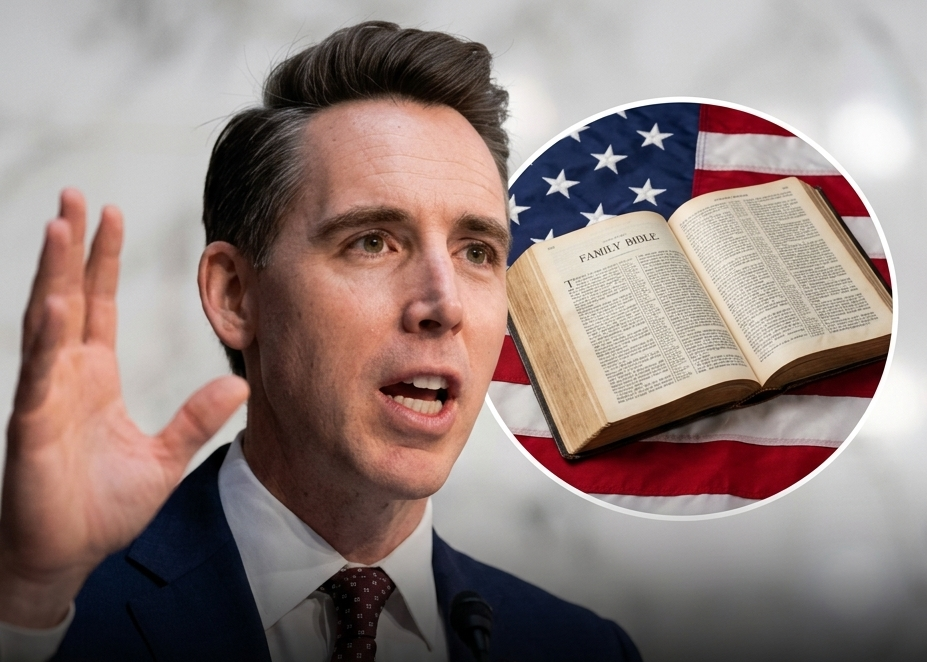
U.S. Sen. Josh Hawley thrust a long-running American argument back into the spotlight in July 2024 by declaring that Christian nationalism “founded American democracy” and that the nation should recover its Christian political tradition. The Missouri Republican’s remarks quickly drew attention because they tied the country’s identity, history, and civic future to explicit Christian belief.
The statement landed with particular force because it did more than praise religion in public life. It framed the nation’s democratic order itself as a product of Christianity, a claim that overlaps with a lively and unresolved debate among historians, church leaders, and Christian commentators about America’s true origins. That debate has only sharpened in recent years as questions about faith, politics, and pluralism have become more charged.
Hawley’s Claim Reopens An Old Fault Line
Hawley’s comments placed him squarely within a broader conservative Christian case that America’s founding cannot be separated from the Bible, Christian moral reasoning, and the religious assumptions of the colonial and founding eras. In that telling, the nation’s institutions did not emerge from a secular vacuum, but from a people shaped by Scripture and a Christian vision of human dignity, law, and responsibility.
His remarks also gave new visibility to the phrase “Christian nationalism,” a term that carries sharply different meanings depending on who uses it. In Hawley’s framing, the phrase describes a political inheritance rooted in Christianity. In other Christian and academic circles, the term often refers to a modern ideology that fuses religious identity and national identity in ways critics say can pressure religious minorities and weaken pluralism.
That tension is at the heart of the current reaction. Supporters of Hawley’s view have used the moment to argue that America’s public life has been untethered from the moral source that made self-government possible. Critics, meanwhile, have treated the remarks as evidence that the language of Christian nationalism remains highly contested and politically potent.
Christian Sources Push Back Into The Founding Debate
Christian advocacy and educational outlets have continued to produce material arguing that America’s founding was deeply shaped by Christian belief. Their case commonly draws on colonial charters, founding-era sermons, early state documents, and the moral reasoning of key figures who saw religion as essential to civic virtue.
These sources often stress that the founders did not imagine liberty as moral neutrality. Rather, they viewed religion as a stabilizing force in public life, and many believed the republic required a virtuous people to survive. That argument has remained especially influential among Christians who worry that American civic life now treats faith as a private hobby instead of a public good.
Other Christian outlets have taken a more careful line. One Christian university analysis has rejected the idea that the founders intended to create a Christian nation, while still arguing that religion was meant to influence public life. The distinction matters. It reflects an ongoing effort inside Christian publishing and scholarship to honor historical complexity without surrendering the claim that biblical faith shaped the nation’s outlook.
Why The Language Still Resonates
The renewed attention to Hawley’s remarks reflects more than a dispute over history books. It also points to anxieties many Christians feel about the direction of American culture, public education, and civic trust. For some believers, the discussion is not academic at all. It is about whether the public square still has room for the moral language that once undergirded common life.
That concern runs through a good deal of Christian commentary on the founding era. These writings often connect Scripture to questions of law, human rights, and social order, arguing that biblical morality gave coherence to ideas like human dignity and accountable government. In that view, America’s institutions were strongest when they remained moored to transcendent truth.
Romans 13 and Proverbs 14 often surface in such reflections, not as proof texts for partisanship but as reminders that authority and wisdom are meant to serve the common good. The older Christian argument is straightforward: a nation cannot long flourish if it forgets the moral source of liberty. That is no small thing.
From Colonial Pulpits To Modern Politics
Supporters of the Christian-foundations argument regularly point back to colonial sermons, covenant language, and the role of churches in shaping early American life. They highlight how ministers influenced public debate before and after independence, often speaking in explicitly biblical terms about freedom, duty, and self-rule.
They also point to the fact that many founding-era leaders, even when not orthodox in a narrow sense, treated religion as necessary to republican life. In this reading, the founders did not all share the same theology, but they did share an awareness that ordered liberty depends on moral restraint. Christian sources often present that conviction as evidence of Christianity’s formative influence.
At the same time, the most careful Christian observers acknowledge that the founders were not uniform in belief and did not all envision the same relationship between church and state. That nuance has not kept the larger argument from gaining traction, especially among Christians who see public reference to the nation’s faith heritage as overdue rather than controversial.
Social Media And Political Reaction Intensify The Debate
Hawley’s remarks generated strong reactions across social media and political circles, where the phrase “Christian nationalism” immediately triggered competing interpretations. For some users, the statements sounded like a proud defense of a Christian moral order. For others, they raised alarms about whether religious language was being used to narrow the meaning of American citizenship.
The intensity of the response reflects the reality that American Christians no longer speak with one voice on the role of faith in politics. Evangelicals, Catholics, Orthodox believers, mainline Protestants, and a range of independent churches often agree that faith shapes public virtue, but they do not always agree on how directly that should appear in public institutions.
Still, the controversy itself shows how central the question remains. The line between acknowledging Christianity’s influence on America and turning that influence into a political program is often thin, and many churchgoers recognize the difficulty of keeping historical memory, civic freedom, and religious conviction in the same frame.
A Debate About Memory, Meaning, And Public Life
Hawley’s comments have therefore become more than a quote cycle. They have reopened a deeper argument about what Americans remember, what they celebrate, and what they think sustains democracy in the first place. Christian writers who support his view see an opportunity to restore language once common in the nation’s public life. Critics see a warning sign.
The Christian response has been just as divided as the political one, though often more carefully argued. Many believers welcome any public acknowledgment that the nation’s moral order was shaped by biblical ideas. Others fear the term “Christian nationalism” will be used to baptize political power or blur the line between gospel proclamation and civic control.
Between those poles sits the enduring Christian conviction that truth matters in public as well as private life. Scripture presents government as accountable, human beings as image-bearers, and justice as something larger than power. However the founding debate is finally judged, that conviction is likely to keep shaping how Christians talk about America’s past and its future.
And for a country still arguing over its roots, that conversation is not likely to quiet soon.