
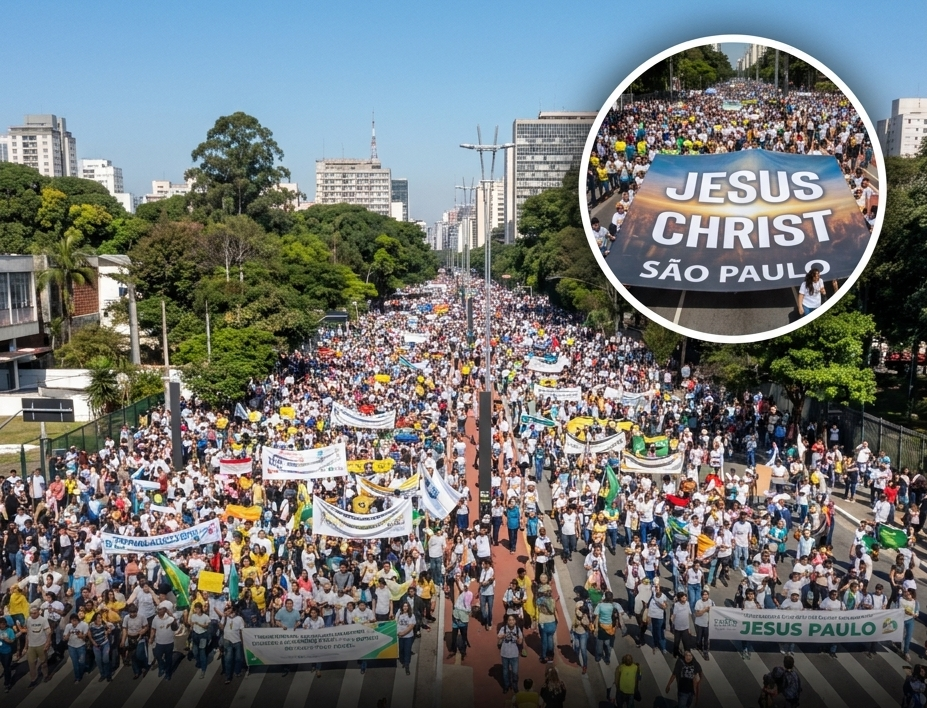
Thousands of Christians filled the streets of São Paulo on Thursday for the 34th annual March for Jesus, turning Brazil’s largest city into a public display of worship, prayer, and gospel music as believers moved from the Luz station area toward the historic center. The event drew churchgoers from across the country and carried a clear message of Christian witness in one of Latin America’s most influential cities.
Coverage of the gathering described it as the country’s largest Christian event, with one report placing expected attendance at more than 2 million and another noting more than 26,000 registered caravans. The scale made the march far more than a local parade. It functioned as a national gathering point for a broad and varied evangelical movement that has grown visibly in Brazil over the past three decades.
A Public March Through The City Center
The route began near Estação da Luz and continued toward Praça Heróis da FEB in São Paulo’s city center, where a large stage hosted hours of music, prayer, and public worship. Multiple sound trucks moved with the crowd, and the day unfolded like a citywide festival of praise rather than a quiet church service.
Reports described the march as peaceful and orderly, with participants singing, carrying banners, and stopping for collective prayer along the way. The event’s format has long been part of its appeal: Christians from different congregations walk together in public, presenting their faith not as a private preference but as a shared confession.
That matters in Brazil, where Christianity remains deeply woven into national life but where public expressions of faith can still carry cultural and social weight. The March for Jesus has become one of the most visible ways believers mark that presence, especially in a major urban center shaped by commerce, politics, and many competing voices.
This year’s march also fit neatly into the Corpus Christi holiday period, giving the gathering an added layer of visibility. In a nation where religious observances often spill into public life, the timing gave the event even more room to draw attention from both participants and observers.
Music, Worship, And A Long-Running Tradition
The program featured extended gospel performances, praise, and prayer, with well-known Brazilian Christian artists among those listed for the worship lineup. Aline Barros, Gabriela Rocha, Anderson Freire, Eli Soares, Thalles Roberto, and Renascer Praise were among the names associated with the day’s music, underscoring how deeply worship culture has shaped the event’s identity.
For many of the people present, the music was not mere entertainment. It served as an act of corporate devotion, one that blended well-known songs with spontaneous prayer and public testimony. In the Christian imagination, that kind of unity echoes the New Testament picture of believers gathered in one place with one heart, lifting praise together.
The march itself is not new. Broadcast reports traced its roots to the 1990s, which means this year’s event continued a tradition that has survived changing political climates, shifts in church culture, and the relentless pace of urban life. Few religious gatherings anywhere have maintained such scale for so long.
That longevity has helped make the March for Jesus a kind of annual marker for Brazil’s evangelical community. It has also made the event familiar to many participants who return year after year, bringing families, church groups, and regional caravans from outside São Paulo.
Political Figures Step Into The Spotlight
This year’s march also carried notable political visibility. Reports placed Flávio Bolsonaro, Governor Tarcísio de Freitas, Mayor Ricardo Nunes, and Ronaldo Caiado among those present or taking part in the public event.
The presence of political leaders at a mass Christian gathering in Brazil is not unusual, but it does highlight the march’s national profile. For elected officials, the event offers access to a large and motivated religious constituency. For church leaders and participants, it can also signal the growing public influence of evangelical Christianity in Brazil’s civic life.
Still, the day’s central focus remained unmistakably religious. The public square, the stage, the music trucks, and the crowds all revolved around praise, prayer, and open confession of faith in Jesus Christ. In a political season, that distinction matters. The march’s identity rests not on partisan slogans but on visible Christian devotion.
Brazil has become one of the most important centers of evangelical growth in the world, and gatherings like this reveal how that growth now occupies public space. The march brought together believers from across regions and denominations, showing a level of cooperation that many churches see as a sign of spiritual strength.
Unity Across Churches And Regions
Organizers and broadcasters emphasized the breadth of participation, with caravans arriving from many parts of the country. The event’s size depended not only on São Paulo residents but on believers who traveled long distances to join the march in person.
That kind of turnout gives the event significance beyond the city itself. It becomes a national signpost, showing how dispersed churches can still gather around a common confession. In a fractured age, that visible unity is one of the march’s most striking features.
The event also reflects the place of public witness in Brazilian Christianity. Participants did not gather behind closed doors. They moved through streets, sang in the open, and prayed in view of the city. For many Christians, that kind of witness corresponds with Jesus’ call for disciples to let their light shine before others.
As Christians around the world continue to navigate questions of faith in public life, the São Paulo march offered a vivid answer from the Brazilian church. It was bold without being combative, large without being chaotic, and devotional without losing its civic presence.
A Sign Of The Church’s Public Voice
The sight of thousands of believers turning a city center into a corridor of worship spoke to something deeper than spectacle. It pointed to a church that still wants to be seen, heard, and counted in the public square.
For many Christians, that is no small thing. In a time when faith is often treated as private or peripheral, the march insisted on something older and more demanding: that Christ is Lord, and that his people need not hide their allegiance.
The event also revealed how worship, music, and prayer can function as a shared language across denominations and regions. Even in a massive crowd, the central focus remained simple and familiar — the name of Jesus lifted up in the open air.
The 34th March for Jesus closed as it began, with sound, prayer, and a crowded city center filled with public praise, leaving behind a clear display of Brazil’s evangelical vitality and a reminder that scenes of Christian unity can still change the feel of a metropolis.