
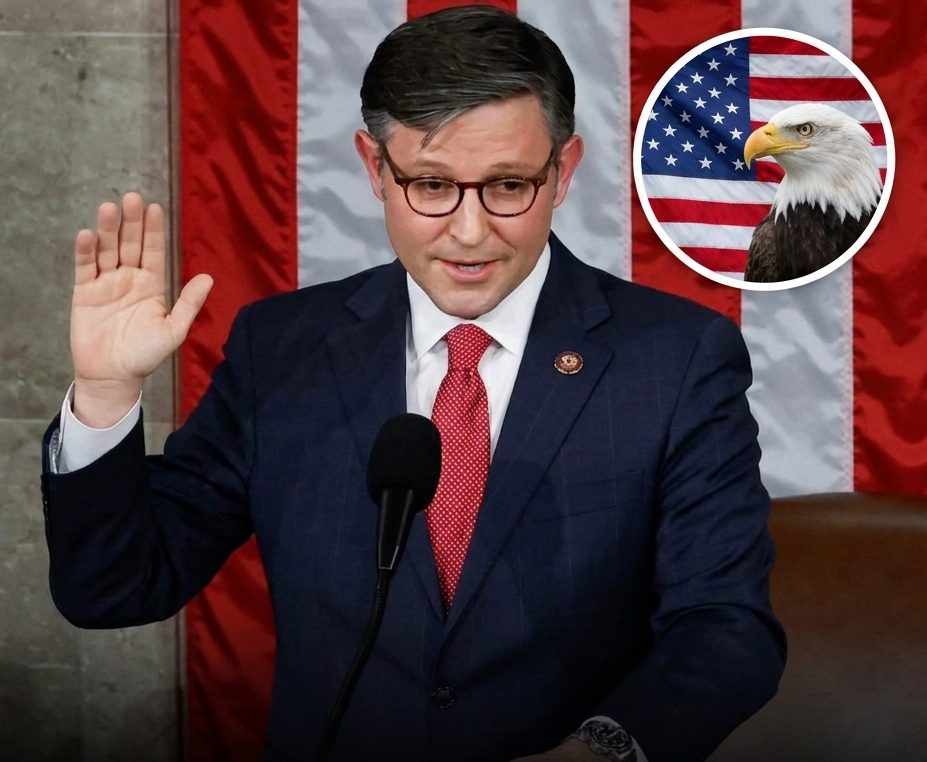
House Speaker Mike Johnson has again placed faith at the center of his public message, arguing that America’s future depends on a return to prayer, biblical values, and the spiritual convictions that shaped the nation’s founding. In recent Christian media coverage, Johnson framed the country’s troubles as part of a deeper moral drift and urged Americans to rededicate themselves to those original ideals.
The Louisiana Republican’s remarks have drawn attention not because they mark a sharp departure, but because they reinforce a pattern that has followed him into national leadership. Johnson has repeatedly presented politics as inseparable from spiritual formation, and he has cast national renewal as something that will not come through legislation alone. It will require prayer, repentance, and a renewed openness to God.
Faith As A National Foundation
Johnson’s argument begins with a familiar but still powerful claim: the United States was built on religious conviction, not secular neutrality. In his telling, the nation’s founding principles grew out of prayer and a public moral imagination shaped by faith. That makes the question of spiritual decline more than a cultural concern. It becomes a civic one.
He has also pushed back on the common use of the phrase “separation of church and state,” describing it as a slogan that is often misunderstood. That view has long circulated in conservative Christian circles, where many leaders argue that the Founders meant to prevent government control over religion, not to banish faith from public life. Johnson’s remarks fit squarely within that tradition.
At the center of his message is a simple appeal: Americans should turn toward prayer again. He has tied that call to the health of families, communities, and the broader public square. The logic runs like this: when people drift from God, institutions weaken; when hearts change, culture can follow.
That is no small thing. It places spiritual renewal before political strategy and moral clarity before partisan advantage. In a media environment that often treats faith as a private matter, Johnson has chosen to speak as if it belongs near the center of national life.
From Political Office To Public Witness
Johnson’s comments matter in part because he holds one of the most visible and contested offices in American politics. As House Speaker, he shapes congressional strategy and helps set the tone for the Republican Party’s public posture. Yet his Christian language often reaches beyond Capitol Hill and into the larger conversation about what kind of nation America is becoming.
Recent Christian coverage has emphasized that Johnson’s framing is less about a single policy proposal and more about a recurring worldview. He links civic stability to spiritual health. He connects public order to prayer. He presents faith as a source of freedom rather than a threat to it.
That approach has made him stand out in a political class that often avoids explicit theological language. It has also drawn support from Christians who see in him a rare willingness to speak about God in a high-profile setting without softening the message for a secular audience.
His message has resonated especially with believers who believe American life has grown too detached from biblical moorings. For them, the issue is not nostalgia. It is urgency. Churches have long warned that moral decline rarely stays contained in one institution, and Johnson’s rhetoric echoes that concern in national terms.
Prayer, Families, And Public Life
Johnson has spoken not only about national founding ideals but also about the daily habits that sustain them. He has urged Americans to strengthen families, live according to biblical principles, and seek God with seriousness. The message is practical as well as spiritual, pointing to habits that belong in homes, congregations, and local communities.
In this sense, his remarks line up with a long Christian tradition that treats renewal as personal before it becomes public. Scripture repeatedly ties the condition of a people to the posture of their hearts. “If my people who are called by my name humble themselves, and pray and seek my face and turn from their wicked ways,” God says in 2 Chronicles 7:14, “then I will hear from heaven and will forgive their sin and heal their land” (ESV).
That verse is often invoked in moments like this because it captures the basic conviction behind Johnson’s message: politics may influence a society, but it cannot replace repentance. Christians across denominations have long debated how directly that principle should shape civic life, but the instinct behind it is widely recognized.
Johnson’s public remarks also reflect a broader belief that many Americans quietly want a return to faith. Recent Christian reporting has treated that sentiment as culturally significant, suggesting that spiritual hunger may still run deeper than many elites assume. In that reading, Johnson is not just expressing a personal conviction. He is identifying a rising longing.
A Broader Christian Conversation
The reaction to Johnson’s comments has unfolded within a wider conversation among Christians about public faith, political leadership, and the limits of government. Some believers welcome any strong defense of prayer and biblical values from a national leader. Others remain cautious whenever religious language becomes closely tied to politics, worried that it can be co-opted or flattened.
That tension is not new. American Christians have always lived with the challenge of affirming spiritual truth while navigating a pluralistic democracy. Johnson’s remarks sit inside that long-running debate, where the question is not whether faith matters, but how it should be expressed in a republic made up of many convictions.
Still, the attention surrounding his comments reveals something important about the moment. Many churchgoers see public life as increasingly untethered from moral discipline. Many pastors see anxiety, fragmentation, and loneliness rising around them. Against that backdrop, a call to prayer feels less like a slogan and more like a diagnosis.
Johnson has leaned into that kind of language before, and the consistency matters. It gives his latest remarks weight beyond a passing comment. He has made faith, prayer, and the nation’s origins central to how he understands governance, and he continues to speak as if America’s renewal must begin there.
For Christian readers, that message lands as both challenge and encouragement: challenge, because repentance is never fashionable; encouragement, because renewal remains possible when a people turns back to God.
Why The Message Keeps Finding An Audience
Part of the reason Johnson’s message continues to gain traction is that it offers hope without pretending the nation’s problems are simple. He does not present prayer as a shortcut or biblical values as a political slogan. He presents them as foundations, the kind that shape character before they shape policy.
That framing has a built-in appeal for Christians who believe the country is in need of more than technical fixes. It also fits a broader conservative Christian instinct that spiritual drift eventually becomes social instability. If that is true, then public renewal must reach deeper than campaign cycles and legislative sessions.
Johnson’s language about rededicating the nation to founding ideals has therefore landed as both historical argument and pastoral appeal. It asks Americans to think not only about what government can do, but about what kind of people they are becoming. And that matters.
In a season when so much public discourse is driven by outrage and fatigue, Johnson’s call to prayer stands out for its simplicity. It reaches for an older language of dependence, one that has long shaped Christian life in America and still speaks to believers who hope the nation’s best days are not behind it.
If his message continues to resonate, it may be because it names a truth many Christians already sense: lasting renewal begins when a nation remembers to seek God again.