
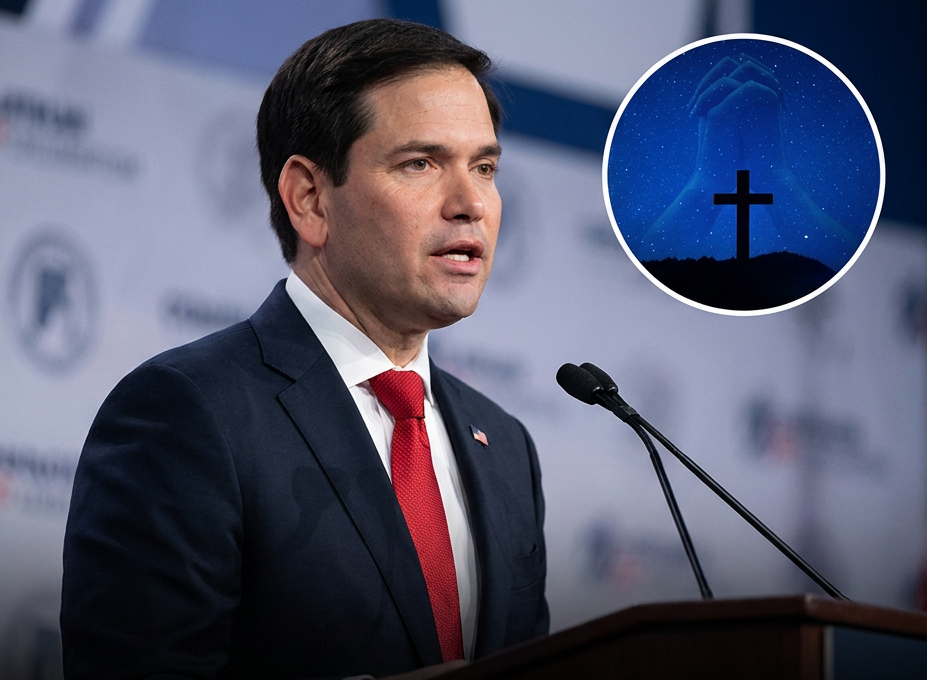
Marco Rubio has once again put his Christian faith at the center of public attention, declaring at his swearing-in as Secretary of State that Jesus Christ is his “Lord and Savior” and describing faith in Him as “the singular purpose of our lives.” The remarks, delivered in Washington, marked the latest and most prominent public affirmation of Rubio’s belief that Jesus alone saves.
The moment drew fresh attention because it came not in a private church setting, but in one of the highest-profile roles in American government. Rubio’s language was explicitly Christian and unmistakably exclusive, placing him squarely within a long line of public figures who have tied identity, vocation, and salvation to the claims of the New Testament.
Rubio Repeats An Old Confession In A New Post
The core of Rubio’s message was not new. More than a decade ago, when he was being described in political circles as a possible “Republican Savior,” he pushed back with a line that has followed him ever since: there is only one savior, and it is not him. That statement framed his political ambition in spiritual terms and drew a clear line between human leadership and Christian redemption.
This time, Rubio carried that same conviction into his new role at the State Department. At his swearing-in, he thanked “Almighty God and my Lord and Savior Jesus Christ,” making faith part of the public moment surrounding the transition into one of the most influential foreign policy posts in the country.
He also described devotion to Christ as “the most important priority,” language that echoed evangelical and orthodox Christian teaching about the lordship of Jesus. For many Christians, that kind of phrasing lands with unusual force when it comes from a cabinet secretary. It is one thing to hear it from a pulpit. It is another to hear it from a national leader with global responsibilities.
Faith Language With Biblical Weight
Rubio’s wording fits squarely within the Bible’s own witness. In the New Testament, Jesus is not presented as one spiritual option among many, but as the only mediator between God and humanity. That conviction sits near the center of historic Christian belief, from the Apostles’ Creed to the confessions of Catholics, Protestants, and Orthodox believers alike.
That is why Rubio’s recent remarks have resonated beyond politics. His language reflects a theological claim that Christians have defended for centuries: salvation is found in Christ alone. In the language of Scripture, there is “one mediator between God and men,” and the Church has repeatedly understood that to mean Jesus is not merely a guide, teacher, or moral example, but Savior and Lord.
Rubio reinforced that same theme in a recent Easter message, where he referred to Jesus Christ as “the Son of God, the king of kings and lord of all nations,” and defended Christians’ right to proclaim “Christ is King.” That language placed his faith not only in personal terms, but in public and cultural ones as well.
A Public Witness In A Skeptical Age
For many Christians, Rubio’s statements arrive at a moment when public expressions of faith are often met with suspicion, especially from elite institutions and online audiences. In that environment, a senior official speaking plainly about Jesus as Savior can feel countercultural. Some believers see it as a rare example of a national leader refusing to compartmentalize faith.
Supporters of Rubio have praised the tone of his remarks because they do not stop at generic spirituality. He did not speak only about values, inspiration, or tradition. He spoke about salvation, lordship, and the exclusive claims of Christ. That matters because Christianity has always hinged on those claims, not merely on moral improvement or cultural heritage.
Still, the comments have generated discussion among people of different faiths and worldviews, especially because Rubio now holds a role that involves representing the United States abroad. A secretary of state must navigate diplomacy across religious and secular lines, and Rubio’s public Christianity inevitably invites scrutiny about how personal conviction and public duty will intersect.
Christianity, Western Identity, And Political Memory
Christian reporting has also shown Rubio linking Christianity to Western civilization, describing the faith as central to the West’s shared history and identity. That argument is not new in American public life, but it carries fresh urgency in an era of cultural fragmentation and religious decline across much of the West.
For many church leaders and lay Christians alike, that connection raises a larger question about whether public officials can acknowledge Christianity’s influence without turning faith into mere cultural branding. Rubio’s recent remarks seem to push in a different direction. They do not only point to Christianity as heritage. They point to Christianity as truth.
That distinction is important. The New Testament does not present Jesus as a mascot for civilizational strength. It presents Him as Lord over all nations, a claim that both humbles political power and relativizes every human system. In that sense, Rubio’s words landed where Christian testimony has always landed best: not at the level of image management, but at the level of confession.
Why The Language Still Resonates
The phrase “Jesus is the only Savior” carries a long theological history, and it remains one of the clearest dividing lines in Christian belief. It leaves little room for vague symbolism or religious pluralism in the modern sense. It is a claim about reality, not merely preference.
That is part of why Rubio’s comments have drawn praise from Christians who see fidelity to biblical teaching as an increasingly costly act in public life. For them, the point is not that Rubio has become a pastor or theologian. The point is that a high-ranking official has spoken in a way that sounds recognizably Christian, even when it might not be fashionable to do so.
At the same time, his remarks also reveal something longstanding about the way Christian politicians navigate public office. They often face pressure to soften the exclusivity of the gospel in order to sound broadly inclusive. Rubio, at least in these recent moments, has done the opposite. He has spoken as if the words of John 14:6 still matter, where Jesus says, “I am the way, and the truth, and the life. No one comes to the Father except through me.”
For Christian readers, that scriptural echo is hard to miss. And that matters, because the heart of the Christian message has never been that human beings save themselves through service, power, or moral effort. The heart of the message is that Christ has done what no one else can do.
Rubio’s latest declaration will likely continue to echo in political circles and church conversations alike, but for believers his message remains as old as the gospel itself: Jesus Christ is Lord, and that confession still calls for public courage.