
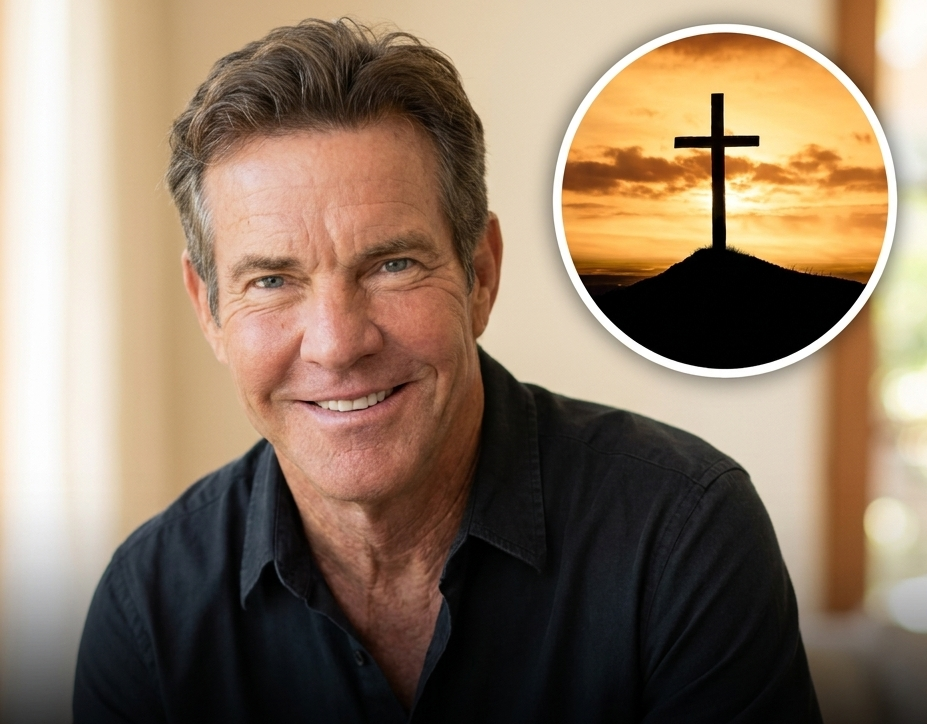
Dennis Quaid has been speaking publicly about how faith in Jesus changed the course of his life, describing a journey that moved from addiction and disillusionment to renewed purpose, prayer, and a personal relationship with Christ. The actor’s recent remarks have drawn fresh attention from Christian audiences, especially as he connects that change to a return to the Bible and the words of Jesus in the New Testament.
At the center of Quaid’s testimony is a simple but decisive turning point: he says the “red words of Jesus” became the part of Scripture that broke through his doubts and redirected his life. For a man whose career has kept him in the public eye for decades, the story has resonated because it does not present faith as a slogan, but as the beginning of a new way of living.
A Return To Scripture And A New Beginning
Quaid has described his spiritual journey as one that began in church, drifted through a season of disillusionment, and then returned to Christianity after a serious reckoning with his own life. In recent Christian coverage, that arc has remained consistent: he moved back to Scripture, encountered the teachings of Jesus with new seriousness, and came to view that moment as the start of his walk with Christ.
The emphasis on the actual words of Jesus has stood out. In a culture where celebrity faith stories can sometimes sound vague or polished, Quaid’s testimony has centered on reading the Gospels, especially the direct words of Christ printed in red. That detail has become more than a literary preference. It has served as a spiritual marker, the point where faith turned from inherited familiarity into personal commitment.
The actor has framed that change not merely as recovery, but as discovery. Addiction recovery often focuses on behavior, discipline, and support systems, and those things matter. But Quaid’s testimony goes further, linking sobriety and stability to a larger question of meaning. He has tied his renewed life to God’s purpose, suggesting that freedom came with clarity about why he was here at all.
That is no small thing. In Christian terms, his story echoes the pattern of repentance and restoration found throughout the New Testament, where grace does not merely remove guilt but also redirects a person’s path. The language fits the language of John 8:36, where Jesus says, “So if the Son sets you free, you will be free indeed” (ESV).
From Addiction To Purpose
Quaid has also spoken about a difficult period marked by drug use, a season that left him searching for something solid enough to hold his life together. That background has made his faith testimony especially striking to Christian readers, because it places his transformation in the context of real struggle rather than a tidy narrative of moral improvement.
His public remarks have stressed prayer, Scripture, and reliance on God through difficult battles. That combination has helped shape the way many Christian outlets have reported the story: not as a celebrity reinvention, but as the kind of change that believers see as evidence of God’s patience and power. It also fits a broad biblical pattern, where people often encounter God most clearly after seasons of failure.
For churches and ministries that work with addiction recovery, Quaid’s story has familiar contours. Shame, isolation, disillusionment, and brokenness often give way to a fresh encounter with grace. The details differ from person to person, but the theological thread is recognizable. The gospel does not begin with self-rescue. It begins with a Savior.
Quaid has also been open about wanting to share his faith more freely. That openness has mattered in an industry where public spiritual language can be cautious or carefully edited. His willingness to speak about Jesus, rather than simply about values or hope, gives the testimony a more direct Christian shape.
Faith In The Public Square
Recent attention has also connected Quaid’s faith to his continued visibility around film projects, including Reagan, where he has remained part of larger conversations about meaning, conviction, and the kind of stories audiences are drawn to. In that setting, his public faith has become part of a broader cultural moment, one in which entertainment figures are increasingly expected to reveal what drives them.
Christian coverage has highlighted that Quaid’s testimony does not sit apart from that public work. Instead, the two have reinforced one another. He has drawn a line between authenticity in art and authenticity in life, suggesting that audiences are hungry for stories with substance and for people who speak honestly about what they believe.
That instinct lands in a wider cultural context where many still look for moral clarity, meaning, and hope. The Christian tradition has long insisted that such hunger is not accidental. Augustine’s ancient reflection that hearts remain restless until they find their rest in God still rings true, even when it is voiced in the vocabulary of modern celebrity testimony.
Quaid’s story has also sparked interest because it reaches across denominational lines. Evangelicals hear the language of conversion and Bible reading. Catholics and mainline Christians may hear the familiar themes of grace, renewal, and recommitment. And believers across traditions can recognize the common center: Jesus Christ as the one who restores what sin has damaged.
Why His Testimony Resonates
The response to Quaid’s remarks has been shaped by more than admiration for a famous name. It has also reflected a deep Christian instinct to rejoice when someone speaks openly about redemption. Scripture repeatedly presents such stories as cause for celebration, from the prodigal son returning home to Paul’s dramatic reversal on the Damascus road.
Quaid’s emphasis on purpose has given the testimony an additional layer. In Christian thought, purpose is not a self-defined project but something received from God. Ephesians 2:10 captures that outlook well: “For we are his workmanship, created in Christ Jesus for good works, which God prepared beforehand, that we should walk in them” (ESV). Quaid’s language has echoed that conviction, even without leaning on theological jargon.
There is also a pastoral dimension here. Public accounts of addiction and restoration can encourage people who feel far from faith or too tangled in their past to come back. Christian writers have long treated such stories carefully because they remind the church that no one is beyond God’s reach. That message matters in an age that often defines people by their worst chapter.
Quaid’s openness about prayer has added another important note. Prayer, in this account, is not ritualistic background noise. It is part of the means by which he says he learned to depend on God through life’s hardest battles. That emphasis resonates with a faith that sees prayer not as an accessory to spirituality, but as the breathing of a living relationship.
A Story Still Unfolding
What makes Quaid’s testimony newsworthy is not only that a well-known actor has spoken about faith. It is that he has tied that faith to concrete change: a return to Scripture, a break from addiction, a renewed sense of purpose, and a public desire to speak more openly about Christ. The story has stayed consistent across recent Christian reporting because the core message is simple and clear.
He has not presented himself as finished. That honesty may be part of why the testimony lands with force. Christian faith, after all, is not mainly about a polished image. It is about a Lord who calls people into ongoing transformation, one step at a time, by the grace that meets them where they are.
For many believers watching the story unfold, Quaid’s journey is a reminder that personal renewal can still break into public life in unexpected places. And that matters, because the gospel has never depended on the strength of the messenger, only on the faithfulness of the One being proclaimed.