
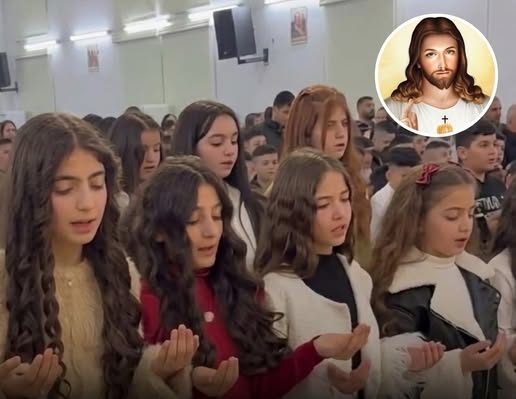
Assyrian Christian children in northern Iraq have been seen praying inside churches again, a quiet but powerful sign that the faith community still endures after years of war, displacement, and jihadist violence. The scenes, centered in Iraq’s north and tied to recent ecumenical observances, have drawn fresh attention to a church that has survived by clinging to worship, family life, and memory.
The image is striking because it carries two truths at once. It shows children at prayer, and it shows a people still living with the ache of loss. Iraq’s Christian population has shrunk dramatically over the past generation, and Assyrian families in particular have borne the weight of forced migration, lost homes, destroyed sanctuaries, and scattered communities.
Faith Preserved In A Wounded Land
Recent Christian reporting from northern Iraq has placed children and families inside churches at the center of a broader story of resilience. The gatherings are not framed as spectacle but as survival, a visible sign that Christian worship continues in a land where it nearly disappeared from entire districts after extremist violence swept through the region.
That matters because Iraq’s Christian story is not recent. Assyrian Christians trace their roots to the earliest centuries of the church, and their liturgy, language, and worship life preserve a memory older than the modern nation itself. In places where martyrdom, exile, and fear have shaped daily life, a child kneeling in prayer becomes more than a devotional image. It becomes a statement of continuity.
The central concern today is not a new crisis specifically targeting praying children. Rather, the reporting points to something more enduring and more sobering: a community still gathering in faith after being repeatedly broken by persecution and instability.
Ecumenical Worship In Northern Iraq
From September 9 to 13, 2025, churches in northern Iraq marked a major ecumenical celebration of the Exaltation of the Holy Cross. The observances brought together the Assyrian Church of the East, Chaldean, Syriac Catholic, and Syriac Orthodox communities in a shared act of worship that reflected both unity and perseverance.
The festival has been described as a sign that faith has survived. It also appears to be becoming an annual fixture after earlier ecumenical celebrations in 2024, suggesting that Christian life in parts of northern Iraq is not only continuing but slowly rebuilding public rhythm. In a region where public Christian expression was violently interrupted, an annual church calendar is no small thing.
Children were part of that public witness. Their presence in churches during prayer and celebration gave visible shape to the hopes of families who have held onto their faith through loss. In Christian terms, the sight carries the same quiet force found throughout Scripture: worship is not reserved for seasons of ease, and praise often rises most clearly from places of sorrow.
A Community Scattered By Violence
Iraq’s Christian communities, including Assyrians, Chaldeans, and Syriac Christians, have been hit hard over decades of conflict. War, sectarian pressure, extremist attacks, and the rise of the Islamic State drove many families from their ancestral towns and villages. Some fled to safer areas inside Iraq. Many others left the country altogether.
Those losses changed the geography of Christian life. In some places, whole neighborhoods emptied. Church buildings were damaged or abandoned. Schools, businesses, and family homes were left behind in rushed departures that often happened in the span of days. The result was not only physical displacement but a deep spiritual wound carried across generations.
The children now seen praying in churches are living inside that history. They are growing up in families that have had to explain why home was lost, why relatives went abroad, and why worship has sometimes required courage. Their prayers are shaped by memory, even when they do not yet understand all of it.
Prayer As Witness And Survival
The beauty of the scene lies partly in its plainness. A church, a family, a child, a prayer. Yet in Iraq, that plainness stands against a harsh backdrop. Faith communities that were once far larger now live with fragility, and many churches operate in settings marked by economic instability, emigration, and unfinished recovery.
Still, the act of prayer remains central. In Christian life, children learning to pray is one of the oldest signs of continuity. It passes down language, hope, and identity. For Assyrian believers in Iraq, that transmission carries unusual weight because it resists the pressure of fear and the erosion that comes with exile.
The biblical imagination gives language to that endurance. Psalm 145:4 in the ESV says, “One generation shall commend your works to another, and shall declare your mighty acts.” In northern Iraq, that verse feels close to the ground. It is visible in families teaching children to cross themselves, kneel, and speak the name of Jesus in churches that have survived against the odds.
Living With Fear, Holding Onto Hope
Reports from Christian media continue to emphasize the fragility of life for believers in the region. Even where overt violence has eased compared with the worst years of Islamic State rule, the memory of persecution remains. Fear does not disappear quickly in communities that have watched armed men burn sanctuaries and empty towns.
That lingering fear helps explain why public prayer still carries emotional force. Church attendance in such places is not casual. It reflects a deliberate choice to remain visible, to continue belonging, and to keep faith alive in the same neighborhoods that once tried to silence it. Children raised in that environment inherit both sorrow and resolve.
At the same time, the ecumenical nature of the recent celebrations offers a more hopeful sign. Assyrian, Chaldean, Syriac Catholic, and Syriac Orthodox Christians have found reasons to stand together in worship, even while maintaining distinct traditions. Shared prayer has become one of the clearest signs that Christian identity in Iraq is being preserved not by power, but by communion.
What The Future Holds For Iraqi Christians
The long-term challenge remains severe. Many Christian families continue to weigh whether to stay in Iraq or leave for good, especially when economic pressures, limited security, and fewer opportunities make daily life harder. Population decline affects everything from parish life to schooling to the survival of village churches.
Still, the recent images of praying children suggest that the Christian story in Iraq has not ended. It has been narrowed, bruised, and tested, but it endures in ordinary acts of worship. For a church that has known exile, that endurance is itself a testimony.
And that is why the sight of Assyrian Christian children praying matters beyond northern Iraq. It points to a people who have suffered much and are still teaching the next generation to trust God, one prayer at a time.