
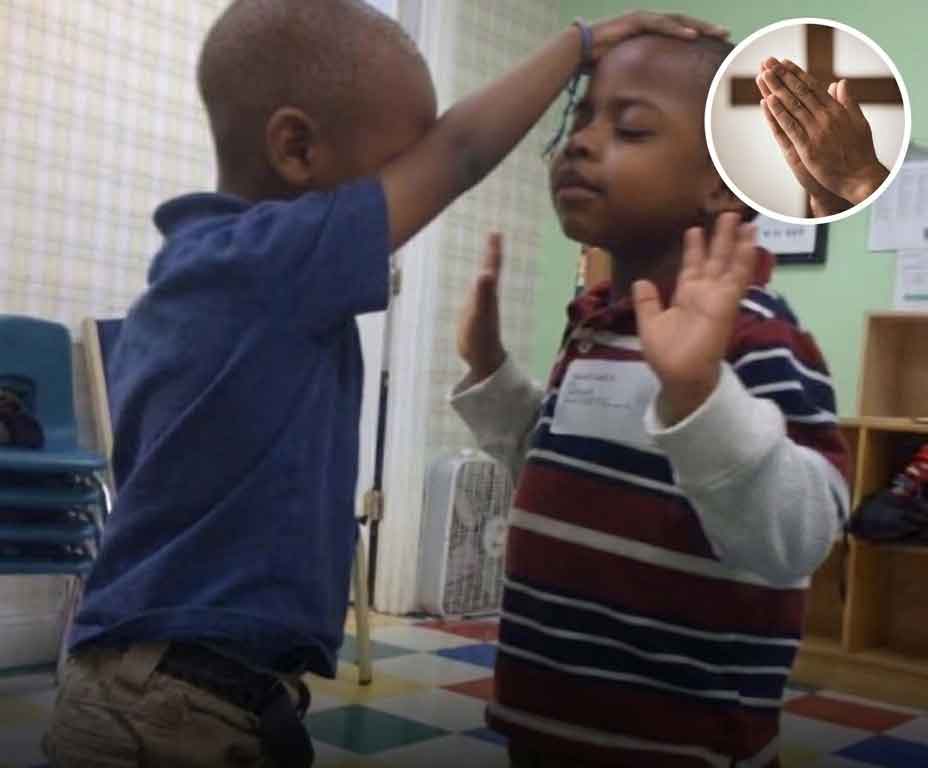
The hum of a typical Tuesday afternoon at the “Little Sprouts” daycare center was nothing out of the ordinary. The air was thick with the scent of apple slices, washable markers, and the gentle chaos of fifteen toddlers navigating the complexities of sharing blocks. Teachers moved with practiced grace, wiping sticky fingers and mediating the occasional dispute over a blue crayon. It was a scene played out in thousands of towns across the country—until four-year-old Leo decided it was time to talk to someone that nobody else in the room could see.
The Moment the Room Went Silent
It happened during the transition from snack time to nap time. Usually, this is the loudest part of the day, characterized by the scraping of plastic chairs and the reluctant protests of children who aren’t quite ready to close their eyes. But Leo didn’t head for his colorful mat. Instead, he stood in the center of the playroom, bowed his head so low his chin tucked into his chest, and clasped his small, dimpled hands together with a ferocity that stopped the lead teacher, Sarah, mid-sentence.
What came out of his mouth wasn’t a rehearsed “Now I lay me down to sleep.” It was a raw, conversational, and incredibly specific plea. In a voice that carried through the suddenly hushed room, Leo began to pray for the “sad man by the fence.” The teachers froze. There was no man by the fence—at least, not one they had noticed. But as Leo continued, describing a man with “torn shoes” and a “heavy heart,” the atmosphere in the room shifted from playful energy to a heavy, sacred stillness.
The Theology of a Four-Year-Old
Adults often complicate faith. We wrap it in liturgy, debate it with doctrine, and shield it with skepticism. We wait for “signs” or demand logical proofs before we commit to a moment of spiritual connection. Children like Leo, however, operate on a different frequency. To a child, the line between the physical world and the spiritual world is paper-thin. They haven’t been taught yet that it’s “weird” to talk to the Creator of the universe about a stranger’s shoes.
Leo’s prayer lasted nearly three minutes—an eternity in toddler time. He thanked “the Big God” for the sunshine, asked for his mommy’s headache to go away, and then returned his focus to the man he claimed was standing just outside the playground perimeter. He spoke with a conviction that left the adults in the room feeling like the ones who were spiritually blind. It was a masterclass in childlike faith: the unwavering belief that someone is listening and that the someone in question actually cares about the smallest details of a human life.
A Discovery That Chilled the Staff
When Leo finally whispered “Amen” and skipped off to his nap mat as if nothing unusual had happened, the staff remained paralyzed. Sarah, driven by a mix of curiosity and a sudden prickle of goosebumps, walked over to the window that overlooked the far end of the playground fence. Hidden behind a thicket of overgrown shrubs—a spot not easily visible from the main teacher stations—sat a man.
He was exactly as Leo had described. He looked exhausted, his clothes were weathered, and he was staring at the ground with a look of profound desolation. The daycare was located near a local transit hub, and it wasn’t uncommon for people to pass by, but this man wasn’t passing. He was sitting in the dirt, seemingly at the end of his rope. When the staff eventually approached him with a bottle of water and a sandwich, the man broke down in tears, explaining he had lost his job and his home that very morning and was contemplating if anyone would even notice if he disappeared.
The Ripple Effect of a Small Voice
The story of Leo’s prayer didn’t stay within the walls of the daycare. As parents arrived for pickup, the teachers recounted the event with hushed voices and tearful eyes. The impact was immediate. One father, a high-powered attorney who admitted he hadn’t prayed in twenty years, sat in his car for ten minutes after picking up his daughter, staring at his own hands and wondering when he had lost that sense of wonder.
Childlike faith is a powerful mirror. It reflects our own cynicism back at us and asks why we stopped believing in the impossible. Leo didn’t need to see a burning bush; he just saw a human being in need and assumed that the God he’d heard about in bedtime stories was the right person to call for backup. This incident serves as a staggering reminder that wisdom doesn’t always come with a college degree or decades of life experience. Sometimes, the most profound theological insights come from someone who still needs help tying their shoes.
Why We Need More “Leo Moments” in the World
In a world that feels increasingly divided and noisy, the simplicity of a child’s prayer offers a different path. It’s a path built on empathy rather than judgment. Leo didn’t ask if the man by the fence deserved help; he didn’t wonder about the man’s politics or his past. He simply saw a “heavy heart” and reacted with the only tool he had: faith.
The power of this moment lies in its purity. When we witness a child engaging with the divine or the spiritual, we are seeing humanity in its most authentic form—before the world tells us to be guarded, before we learn to be embarrassed by our hope, and before we decide that some people are beyond saving.
Turning the Extraordinary Into the Every Day
As the “Little Sprouts” daycare returned to its normal routine the following week, things weren’t quite the same. The teachers started a “gratitude jar.” The parents started talking more about the emotional well-being of their kids rather than just their milestones. And the man by the fence? With the help of the daycare community, he was directed to a local shelter and a job placement program, proving that Leo’s prayer didn’t just go upward—it moved outward.
We often tell children that they have a lot to learn from us. We teach them math, manners, and how to navigate the world safely. But perhaps we have it backward. Perhaps the most important lessons are the ones they are inherently born with: the ability to see the invisible, the courage to speak to the silence, and the unwavering belief that a few whispered words can change the world for a man with torn shoes. Leo’s prayer wasn’t just a daycare highlight; it was a wake-up call to everyone who had forgotten how to believe in the power of a simple, honest “please.”