
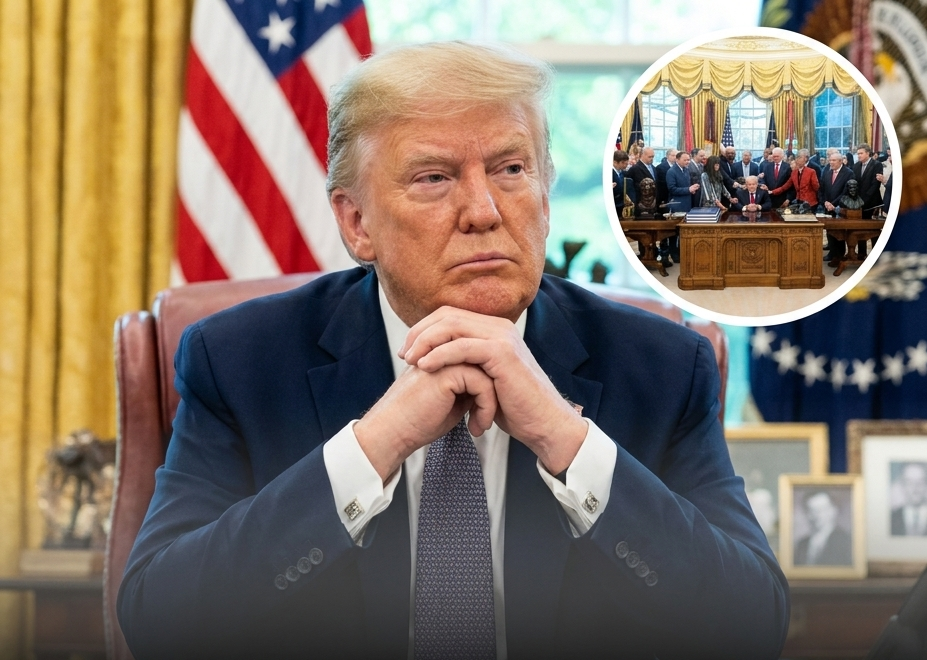
President Donald Trump used a White House faith event to call for more prayer in America, linking the appeal to his broader push to restore religion’s public role and expand the administration’s faith agenda in Washington. The event, held amid a series of White House initiatives aimed at religious liberty and national renewal, placed prayer at the center of a political and spiritual moment.
The latest focus falls on the administration’s effort to encourage Americans to pray for the country as it moves toward the 250th anniversary of the Declaration of Independence. That campaign, framed as an invitation rather than a mandate, fits neatly alongside the White House Faith Office and a wider set of faith-centered gatherings that have drawn pastors, ministry leaders, and believers into the nation’s capital.
The White House Faith Push
Trump’s remarks at the event centered on the idea that religion should have a larger place in American life. The message matched the administration’s repeated emphasis on religious freedom, public prayer, and support for people of faith, themes that have become a regular feature of White House faith-related appearances.
The White House Faith Office, established in the West Wing, has been presented as a central hub for those efforts. Its purpose has been tied to defending religious liberty and strengthening ties with faith communities across the country, especially as the administration seeks to contrast its approach with policies it has framed as hostile to religious conviction.
That posture has resonated with many evangelical, Catholic, and other Christian leaders who see the erosion of public faith language as one of the defining cultural shifts of recent years. At the same time, the White House’s approach has drawn attention well beyond any one denomination, because prayer and freedom of worship remain core concerns for Christians across the theological spectrum. And that matters.
America Prays And The 250th Anniversary
One of the clearest expressions of the administration’s faith agenda is America Prays, a national invitation for Americans to form prayer groups and set aside weekly time to pray for the country. The effort is tied to the lead-up to America’s semiquincentennial, when the nation will mark 250 years since the signing of the Declaration of Independence.
The initiative has been presented as a spiritual preparation for a historic civic milestone. Its emphasis is simple: prayer as a public act of renewal, not merely a private devotion. In a political culture often dominated by noise, that kind of invitation carries its own force.
For many Christians, the timing is significant. The declaration of independence shaped the nation’s identity, but prayer has long shaped its religious imagination, from colonial revivals to wartime days of intercession to church-led calls for repentance during national crises. The new White House initiative taps into that older pattern, even if it arrives in a sharply different political era.
Faith Leaders Gather In Washington
The White House event came as a larger faith gathering in Washington drew national attention, bringing together pastors, ministry leaders, and believers for hours of worship and intercession. The atmosphere reflected the growing visibility of faith-based events in the capital, where prayer meetings have increasingly become part of the political and cultural calendar.
Supporters of the gathering see more than symbolism. They view these moments as a public witness that prayer still belongs in the nation’s story and that spiritual renewal cannot be separated from civic health. Their view echoes a long Christian conviction that national life and moral life are connected, even if churches disagree on how that connection should show up in policy.
The event also underscored a broader reality: faith communities remain among the most organized and socially influential groups in the country. Whether in large evangelical networks, Catholic dioceses, Black church traditions, Orthodox parishes, or immigrant congregations, prayer for the nation is a familiar part of Christian practice. What changed here was the platform, not the impulse.
Religious Liberty Remains A Central Theme
Trump has repeatedly tied his faith-event appearances to religious liberty, a subject that continues to animate many Christian voters and church leaders. In official framing, the administration has sought to present itself as a defender of believers facing cultural pressure, legal disputes, or what it describes as anti-faith assumptions in public institutions.
That theme has particular resonance among Christians who believe public life has grown increasingly inhospitable to religious conviction. Concerns over conscience protections, speech restrictions, school policies, and the role of faith-based organizations have all sharpened the sense that something vital is at stake. The White House has turned those concerns into a visible part of its messaging.
Still, the moment is not only political. Christians have long understood prayer as a summons to humility before God, not a slogan for institutional branding. Scripture gives that posture clear language in 2 Chronicles 7:14: “if my people who are called by my name humble themselves, and pray and seek my face and turn from their wicked ways, then I will hear from heaven and will forgive their sin and heal their land.” That verse has surfaced often in American religious life for a reason.
Prayer, Policy, And Public Witness
The White House push raises a familiar question for believers: what happens when prayer enters the machinery of government? For some Christians, the answer is encouraging because it creates room for public acknowledgment of God in a culture that often sidelines faith. For others, it requires caution, because political language can turn prayer into a symbol rather than a discipline.
Even so, the present moment shows how deeply prayer still shapes American Christian identity. Faith leaders routinely call for intercession during elections, crises, and moments of national division. Trump’s invitation through the White House gives that pattern an unusually prominent public stage, one that extends beyond church walls and into the center of civic power.
The administration’s faith events also reveal the enduring strength of religion as a public force, despite predictions for years that secularization would erase it from the political conversation. The White House has instead moved in the opposite direction, building a visible faith apparatus and urging Americans to respond with prayer. That is no small thing.
What Comes Next
As the country moves closer to the 250th anniversary of the Declaration of Independence, the administration appears determined to keep religion woven into the national conversation through events, outreach, and organized prayer. The White House Faith Office and America Prays suggest a longer campaign rather than a one-time announcement.
For churches, the development offers both an opportunity and a test. It opens space for public prayer and renewed attention to religious liberty, but it also invites believers to consider whether national renewal can ever endure without genuine repentance, reconciliation, and faithfulness. In the language of the Bible, prayer is never merely decorative; it is a plea for God’s mercy and guidance.
For now, the White House has made clear that prayer will remain part of its public message, and many Christians will be watching to see whether the call to seek God resonates beyond the walls of Washington and into the life of the nation.