
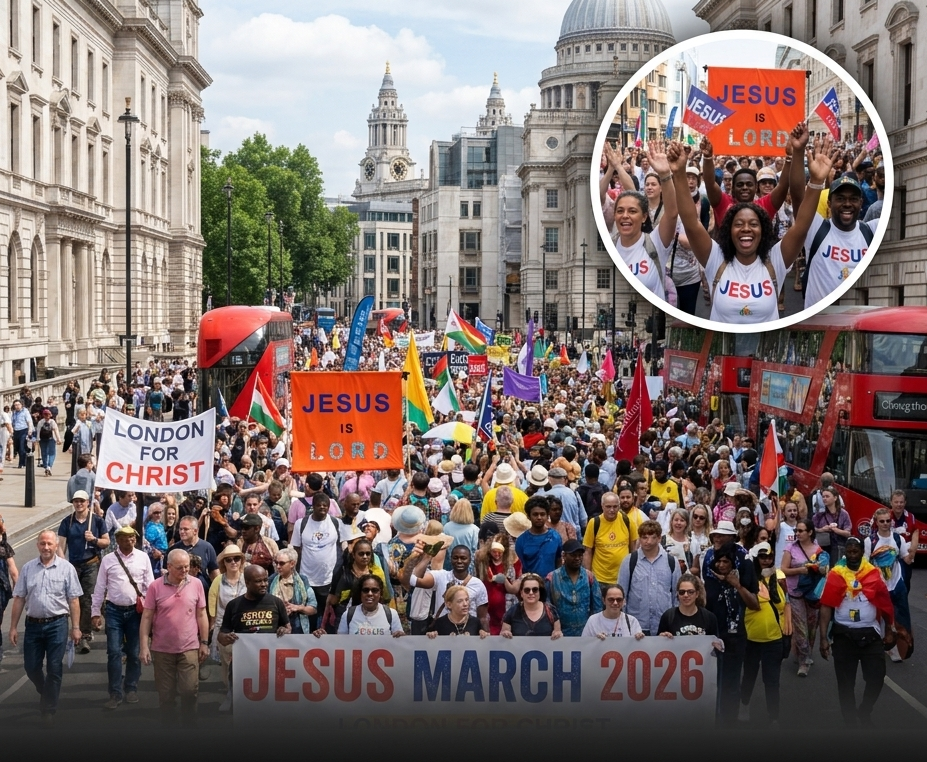
About 7,000 Christians filled central London for the Jesus March 2026, turning the city’s streets into a public celebration of faith marked by worship, prayer, music, and evangelism. The gathering, held over the Pentecost weekend, drew believers from many churches and backgrounds who wanted to proclaim Jesus in the heart of the capital.
The march moved through one of Europe’s most watched cities with a very different spirit from the political demonstrations that often dominate headlines. Organizers framed the event as a witness, not a protest, and participants treated it as a joyful declaration that Christianity still has a visible place in public life. That matters in a country where public faith often feels quieter than it once did.
A Public Witness In The Heart Of London
Participants carried banners, sang worship songs, and joined in prayer as crowds made their way through central London. The atmosphere was described as celebratory and unmistakably Christian, with the focus placed on Jesus rather than on policy battles or culture-war language.
The event drew attention because it brought a large number of Christians into a prominent civic space at a time when public religion in Britain often appears subdued. London, with its mix of churches, mosques, synagogues, temples, and secular institutions, remains a symbol-rich city, and the sight of thousands of Christians moving through it carried its own message.
Christian coverage of the march has emphasized that it was not built around grievance. Instead, it centered on worship and testimony, with many present viewing the day as a visible reminder that faith is still alive and active in the United Kingdom.
The Pentecost timing added another layer of meaning. For many Christians, Pentecost recalls the day in Acts 2 when the Holy Spirit empowered the church to speak boldly and publicly. The march’s emphasis on proclamation and unity fit naturally within that biblical frame.
Why The Number Matters
The reported turnout of roughly 7,000 made the event large enough to stand out even in a city used to major public gatherings. It was not a small street ministry or a niche church outing. It was a sizable convergence of Christians willing to step into the center of London and be seen.
That scale also gave the event symbolic weight. In recent years, public expressions of Christianity in Britain have often been discussed in terms of decline, marginalization, or cultural retreat. A large, peaceful, worship-filled march offered a different picture, one that suggested confidence rather than defensiveness.
Writers covering the gathering have described it as part of a broader renewal of public Christian visibility in the UK. Whether viewed as a one-day event or a sign of something larger, the march added to a growing sense that many believers are no longer content to keep faith entirely private.
And that is no small thing. In a society where religion is often treated as personal but not public, a mass Christian gathering in central London carries both cultural and spiritual significance.
Unity Across Church Backgrounds
One of the most notable features of the march was the breadth of participation. Christians from different churches and traditions came together under a single focus, and the event reflected a shared desire to lift up Christ rather than denominational differences.
That kind of unity has long mattered in Christian witness. Jesus’ prayer in John 17 for his followers to be one has often been read as both a spiritual call and a public testimony. When believers from varied backgrounds gather with a common purpose, the result can be more than a crowd. It can be a sign of shared conviction.
The march also linked worship with evangelism. That combination shaped the event’s tone from beginning to end. Rather than treating evangelism as a separate activity, participants appeared to fold proclamation into song, prayer, and street-level presence.
For many churches, especially in a post-Christian cultural setting, this kind of public faith raises familiar questions about visibility, courage, and credibility. Yet the London gathering suggested that many believers see public witness not as an optional extra, but as a normal expression of discipleship.
What Made It Distinct From Other London Gatherings
The Jesus March was described as a faith-centered event, and that distinction is important. London has seen a range of marches and rallies that may share the same streets but not the same purpose. Some have been political or issue-driven; others have included Christian symbols or faith language without being fundamentally Christian gatherings.
This march was presented differently. Its focus rested on worship music, prayer, testimonies, and the public celebration of Jesus. The goal was not to make a political point, but to make a spiritual one.
That difference helps explain why the event drew attention from Christian observers. The gathering seemed to embody a distinct kind of public presence, one that aimed to bless the city while also calling it to consider the gospel message.
At a time when religion in public life is often reduced to controversy, the march offered a quieter but no less forceful alternative. Joy can be a form of witness. So can unity. So can a crowd that sings instead of shouting.
The Wider Spiritual Climate In The UK
The march comes amid continuing discussion about the place of Christianity in modern Britain. Church attendance remains uneven, and many congregations continue to navigate decline, secularization, and questions about relevance. But alongside those pressures, there are also signs of fresh interest in faith, especially among younger people and in public worship events.
That wider context helps explain why a Christian march through central London has resonated beyond the event itself. It has been interpreted by some as part of a broader spiritual shift, one in which believers are becoming more willing to speak openly about Jesus in public spaces.
Historically, London has been a city where Christian processions, street preaching, and public acts of worship have all played a role in shaping the imagination of the church. The March for Jesus style of gathering taps into that older pattern, even as it carries a distinctly contemporary feel.
The event also speaks to the enduring Christian conviction that faith is not meant to be hidden away from ordinary life. In the New Testament, public witness often happens in marketplaces, synagogues, roads, and city squares. The London march borrowed that same instinct for visibility.
What Christian Leaders And Churches Will Watch Next
The immediate question now is whether the momentum from the march will continue in local churches, evangelistic outreach, and future public gatherings. Large events can inspire, but lasting impact usually depends on what follows after the crowds go home.
Many churches will likely look at the march as a reminder that people still respond to clear, joyful, unapologetic Christian witness. In a crowded and often anxious culture, public worship can cut through the noise in a way that arguments alone cannot.
It will also be worth watching whether the event encourages more collaboration across denominations. The march’s broad participation suggested that Christians from different traditions can still gather around a shared confession with real unity and purpose.
The image left by the day was simple but striking: thousands of believers in the center of one of the world’s major cities, worshiping openly and making room for hope. For Christians who read the book of Acts as a living pattern, that kind of public faith still sounds familiar, and still feels like good news.