
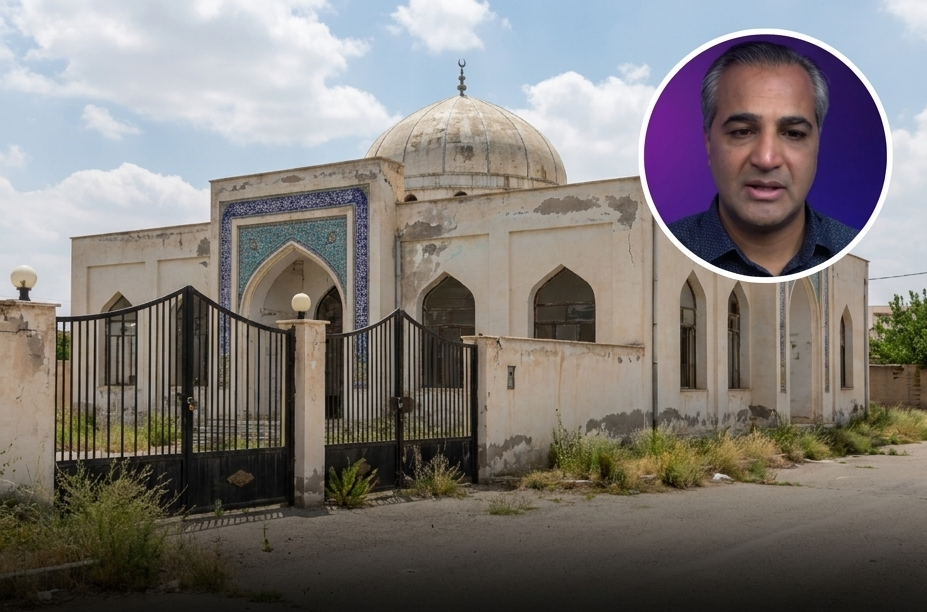
Mohamad Faridi, a former Muslim now presented in Christian media as an Iranian Christian leader, is drawing attention to what he sees as a wider religious shift inside Iran. In recent broadcasts, he linked the reported closure of thousands of mosques to growing rejection of Islam and rising interest in Christianity, especially through Iran’s underground church.
The claim at the center of his message is stark: that 50,000 of Iran’s 75,000 mosques have closed in recent years. In the Christian coverage that circulated Faridi’s comments, that figure was used to argue that Islam’s institutional grip is weakening while spiritual searching is spreading in quieter, less visible ways.
Religious Decline And Quiet Curiosity
Faridi’s remarks come at a time when Christian ministries have increasingly described Iran as a place of paradox. Public religion remains tightly controlled, yet reports of private faith, informal Bible study, and house churches continue to surface. That tension has become one of the defining themes in the Christian picture of Iran.
In that telling, the closing mosque doors do not simply signal fewer worshippers. They point to a deeper shift in the country’s religious mood, where many people appear disillusioned with official Islam and open, at least privately, to alternatives. Christianity has become one of the most visible of those alternatives.
Faridi’s own story gives that narrative a face. Christian ministries describe him as having grown up in a devout Muslim environment in Iran before later coming to faith in Christ. His testimony has also circulated in video form, where he describes leaving Islam and eventually joining an Iranian church plant after arriving in the United States as a refugee.
The Underground Church Gains Ground
One recurring theme in Christian reporting is the resilience of Iran’s underground church. Despite arrests, surveillance, imprisonment, and even executions, the church is often portrayed as expanding beneath the surface. The growth is not easy to measure precisely, but the same reports repeatedly describe it as one of the fastest-growing underground Christian movements per capita.
That growth matters because it comes in a country where conversion from Islam carries enormous social and legal risk. For many Iranian believers, faith does not begin in a sanctuary with a steeple. It begins in living rooms, through secret meetings, whispered prayer, and the careful passing of Scripture from one person to another.
Christian outlets emphasize that the church in Iran is not growing only through organized gatherings. Many people are encountering Christianity through dreams, visions, Bible downloads, online sermons, and trusted friends. In a nation where religious life is closely monitored, digital access has become a surprising doorway.
From Mosques To House Churches
The contrast between empty mosques and crowded secret gatherings sits at the heart of Faridi’s message. In the Christian interpretation of the story, mosque closures represent more than the loss of buildings or attendance. They reflect a broader erosion of confidence in the religious system that has shaped public life under the Islamic Republic.
At the same time, house churches are said to be offering something many Iranians find lacking elsewhere: personal encounter, spiritual hope, and a faith that is shared rather than enforced. That is no small thing. The Christian framing suggests that people are not merely leaving one religion behind but searching for a living answer to deeper questions.
In the biblical imagination, that search is familiar. The Gospel of John records Jesus saying, “I am the way, and the truth, and the life” (John 14:6, ESV). Christian observers often point to that verse as a lens for understanding why some Iranians are turning toward Christ while stepping away from Islam.
Faridi’s Story And The Larger Pattern
Faridi’s background has made him a compelling voice in Christian media. He is consistently described as someone shaped by Iran’s Islamic system who later crossed over into Christian belief and then into advocacy for Persian believers. His life story is presented as part testimony, part warning, and part proof of a broader movement.
That personal arc matters because stories of conversion can carry unusual force in persecuted settings. A former insider can speak to the pressures, expectations, and losses that come with deserting the faith of one’s upbringing. In Faridi’s case, that testimony is being used to illustrate what Christian ministries view as a widening spiritual opening across Iran.
The narrative also resonates with many Christians outside Iran because it fits a longtime pattern in global mission work: persecution does not always extinguish faith. Sometimes it sharpens it. Sometimes it drives believers underground, where the church becomes less visible but more committed.
Pressure, Risk, And Persistence
None of this has made life easier for Iranian Christians. Christian coverage continues to describe a climate of pressure, with surveillance and arrests shaping daily life for many believers. Public conversion remains dangerous, and house churches operate with caution because exposure can lead to heavy consequences.
Yet the same reports insist that fear has not stopped the movement. Instead, it has pushed believers into deeper dependence on secrecy, community, and prayer. In that sense, the growth of the underground church has become one of the most striking features of Iran’s religious landscape.
The Christian interpretation of the moment is not simply that Islam is weakening. It is that many Iranians are now willing to look beyond the state’s religious framework in search of something more personal and durable. For believers who follow developments in the region, the reported mosque closures and the spread of secret fellowships appear connected, not separate.
A Story Still Unfolding
Faridi’s comments have landed in a larger conversation about religion, control, and belief in one of the world’s most tightly regulated societies. The exact scale of mosque closures remains part of the reported Christian narrative rather than independently verified public data, but the broader trend described in those accounts is consistent: public Islam appears to be losing its hold while private Christianity grows more resilient.
For Iranian Christians, that creates a complicated picture. The church grows under threat, but it grows. Bibles move through phones and hidden networks. New believers continue to emerge from Muslim backgrounds. And stories like Faridi’s keep circulating because they seem to capture what many think is happening beneath the surface.
In a country where official religion has long defined public identity, the quiet spread of house churches and the closing of mosques suggest that something deeper than politics is shifting, and for many Christians watching Iran, that shift looks a lot like the slow work of God among a people still searching for truth.