
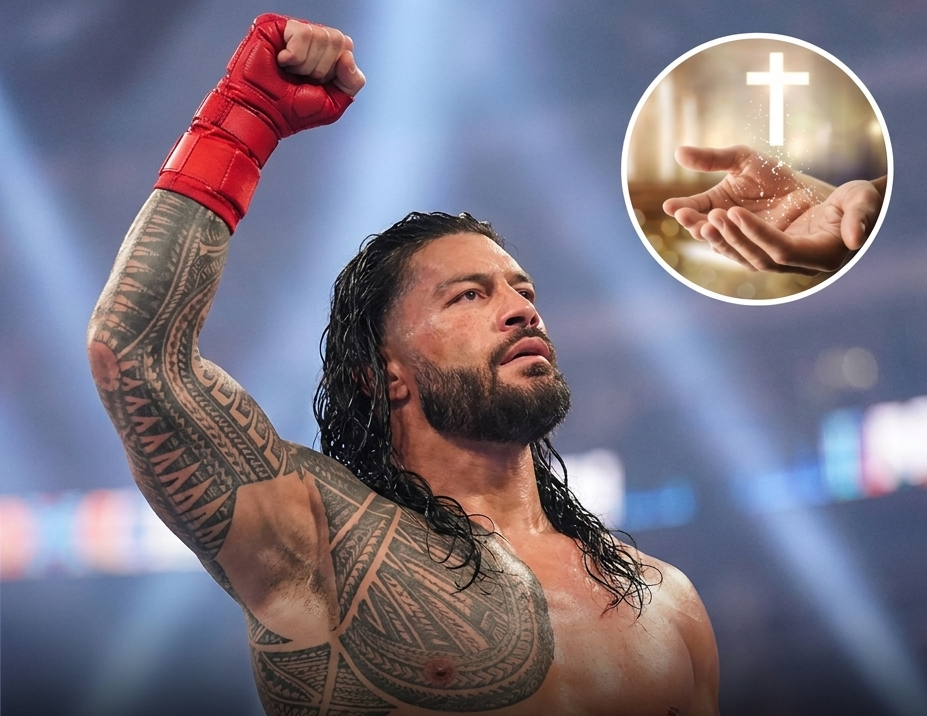
Roman Reigns publicly affirmed his faith in Jesus Christ in a recent conversation, bringing one of professional wrestling’s biggest names into a conversation far larger than the ring. The WWE superstar said nothing is possible without God, identified Jesus Christ as the Son of God, and connected that belief to Christ’s death for sin.
He also said he was born and raised Catholic, placing his comments within a familiar Christian framework rather than a vague appeal to spirituality. That distinction matters, especially in a media culture where public faith statements are often softened until they lose their center.
A Public Confession With Clear Christian Language
Reigns’ remarks have drawn attention because they were not simply about optimism, discipline, or gratitude. They went straight to the heart of classical Christian confession: God is sovereign, Jesus Christ is divine, and the cross is central to salvation.
For Christian readers, the language stands out for its clarity. Reigns did not limit himself to saying he believes in a higher power. He tied faith to Christ’s identity and saving work, echoing a conviction that has defined Christianity from the beginning.
That is no small thing. In entertainment, religious language is common, but specific confession is rarer. Reigns’ comments place him among a small group of major public figures willing to speak plainly about Jesus without turning the message into something generic.
Faith As A “True North Star”
Reigns also framed belief in God as essential to success, identity, and purpose. He described faith as a kind of “true north star,” suggesting that Christian belief is not an accessory to life but a guide for how life should be lived.
That idea fits well with a biblical understanding of direction and discipleship. Scripture repeatedly presents God not as one influence among many, but as the one who orders human purpose and steadies human steps. Proverbs 3:5-6 remains a fitting lens: “Trust in the Lord with all your heart, and do not lean on your own understanding.”
In Reigns’ case, the emphasis on God as a source of grounding arrives at a moment when many public figures speak carefully around religion. His words, by contrast, pointed toward conviction rather than ambiguity. They also gave Christian audiences a rare glimpse of a high-profile athlete speaking in explicitly Christ-centered terms.
Why The Statement Resonated Online
The response across social media reflected more than celebrity interest. Many Christians responded with encouragement because the statement carried familiar doctrinal weight. Jesus as the Son of God. Jesus who died for sins. Faith that shapes identity. Those are not fringe ideas within Christianity; they are the center.
In a culture often skeptical of public religion, Reigns’ comments cut against the grain. Many athletes and entertainers mention belief in broad, noncommittal terms. By contrast, his words named Christ directly and attached meaning to the cross.
Biblical Christianity has always insisted that Jesus is not simply a moral teacher or inspirational figure. The New Testament presents him as the eternal Son who gave himself for sinners. Romans 5:8 captures that claim with clarity: “but God shows his love for us in that while we were still sinners, Christ died for us.”
A Longer Pattern Of Open Faith
These comments did not emerge in a vacuum. Earlier Christian reporting had noted that Reigns has not hidden his belief in God and has pointed to prayer during his cancer battle. That history gives added weight to his latest remarks, which appear to move from private dependence toward more public acknowledgment.
For many Christians, that arc will sound familiar. Crisis often clarifies conviction. Suffering can strip away performance and leave a person speaking with unusual directness about what holds them together. In the Christian life, dependence on God is rarely tested more sharply than in seasons of illness and fear.
Reigns’ cancer battle had already made his story more than a sports profile. It became a story of endurance, family, and carrying burden in public. His faith comments now add another layer, showing how illness and recovery can deepen spiritual seriousness rather than diminish it.
The Significance For Christian Audiences
For Christian readers, the most notable part of the story is not merely that Reigns believes in God. It is that he identified Jesus Christ by name and connected him to the saving work of the cross. That is the kind of language church historians, pastors, and ordinary believers immediately recognize as foundational.
It also matters that he identified himself as Catholic. In a broadly Christian landscape, that detail reminds readers that public faith expression often crosses denominational lines, even when believers differ on doctrine, worship style, or tradition. The central confession of Christ’s lordship remains a point of common ground.
At the same time, Reigns’ remarks invite reflection on how Christian testimony works in public life. A person may speak from a stage, a locker room, or a stadium, but the content of the confession still matters. Jesus called his followers to acknowledge him openly, and Matthew 10:32 remains unambiguous: “So everyone who acknowledges me before men, I also will acknowledge before my Father who is in heaven.”
More Than A Celebrity Moment
There is always a temptation to reduce a statement like this to mere celebrity content. But the substance of Reigns’ comments makes that too shallow. He did not merely invoke God as a comforting phrase. He identified the person of Christ, the purpose of the cross, and the guiding role of faith in life.
That combination has resonated because it sounds strangely old-fashioned in the best sense. It is basic Christianity, spoken plainly. And in a moment when many people are unsure what public faith should look like, clarity still carries a surprising force.
Reigns’ words may not settle debates about religion in entertainment, nor do they need to. Their value lies in their simplicity. A major sports figure spoke openly about Jesus, and for many Christians, that alone felt like a reminder that faith can still be declared without apology.
For a culture that often rewards hesitation, his confession offered something different: a public witness that placed Christ at the center and left the rest to follow.