
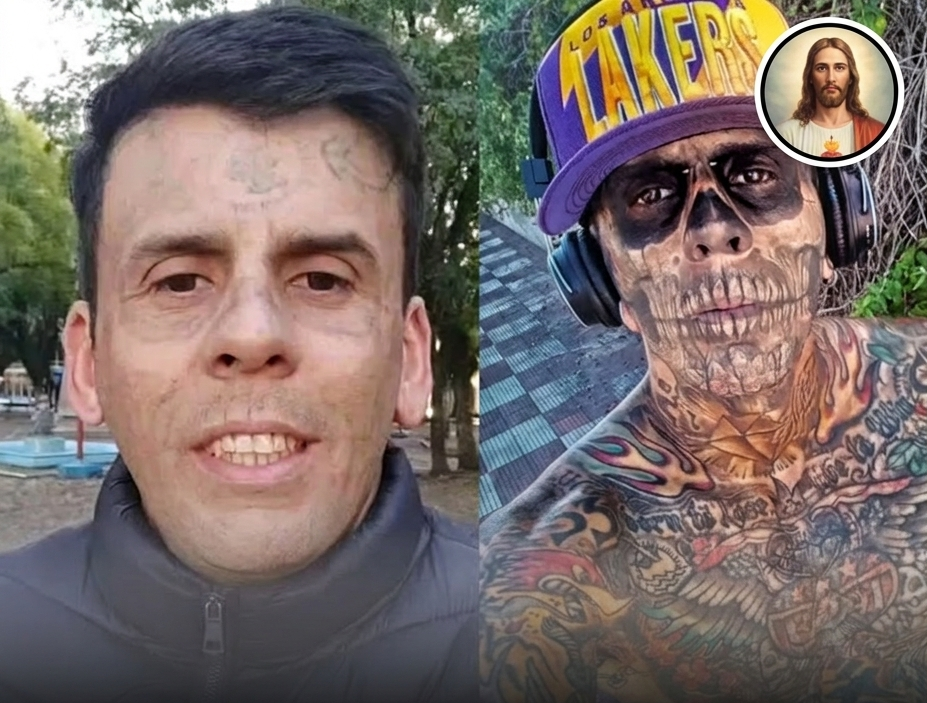
Leandro de Souza, once widely recognized in Brazil as the country’s “most tattooed man,” is now drawing attention for a very different reason: he is continuing the removal of the tattoos that once covered more than 95 percent of his body after converting to Christianity in southern Brazil.
The change has become more than a cosmetic process. Christian reporting now places his story in the larger frame of conversion, discipleship, and future ministry, with recent coverage saying he has received a scholarship for theological training and possible missionary work. That shift has turned a striking personal makeover into a testimony of spiritual restoration.
From Heavy Ink To A New Beginning
De Souza’s body once carried more than 170 tattoos, giving him a public identity that set him apart wherever he went. His appearance became part of his notoriety, and for years the tattoos marked the old life he later said he wanted to leave behind.
That turning point came in Bagé, a city in southern Brazil, where he encountered an evangelism group at a municipal shelter. He later attended church and was baptized 15 days afterward, marking the beginning of a rapid and visible break from his former path.
Since then, he has begun the painful and expensive process of removing the tattoos that remain most visible, including those on his face. Christian media reports describe the work as being supported free of charge by a specialized studio, making the physical process of change possible as he pursues a new life in Christ.
That matters because the story is not only about removing ink. It is about reordering identity. For many Christians, that is the heart of conversion: the old passes away, and a new life begins, echoing 2 Corinthians 5:17, where Paul writes, “if anyone is in Christ, he is a new creation. The old has passed away; behold, the new has come.”
Baptism, Discipleship, And Daily Faith
De Souza now attends Assembleia de Deus in Bagé, one of Brazil’s largest Pentecostal fellowships, and his life reportedly includes evangelism and social outreach as he continues to grow in faith. The story has moved beyond a one-time decision and into the slower, quieter work of discipleship.
That is often where the public conversation gets more interesting. In many conversion stories, the first visible change captures attention, but the deeper change comes later in habits, community, and calling. De Souza’s experience appears to be following that pattern, with church life and service replacing the isolation that often shadows addiction, instability, or reinvention.
His tattoo removal has become an outward sign of inward transformation. The visible change is dramatic, but the Christian framing gives it broader meaning: not just leaving behind a former image, but stepping into repentance, restoration, and responsibility.
Brazil has long been fertile ground for such stories, especially within the country’s vibrant evangelical and Pentecostal landscape. Churches there often combine evangelism, practical care, and a strong emphasis on testimony, which can make personal transformation highly visible and widely shared. De Souza’s story fits that environment closely.
A Scholarship Opens A New Path
The newest development is perhaps the most significant. Christian reports say De Souza has received a scholarship that will allow him to leave his job, relocate within Brazil, and train full time for ministry. The plan includes a move to Pernambuco, where he is expected to study at an evangelical seminary.
That step changes the story from recovery to vocation. Rather than simply leaving an old identity behind, he is preparing for a future shaped by teaching, formation, and service. The reported path toward missionary work suggests that church leaders and supporters see more than a powerful testimony; they see a potential minister.
In practical terms, the scholarship removes a major barrier. Seminary training usually requires time, money, and a stable setting, all of which can be difficult for ordinary believers pursuing ministry. For De Souza, the support makes it possible to move from a local testimony in Bagé to formal preparation for wider service.
His expected relocation to Pernambuco also signals how seriously the development is being treated. Seminary training in Brazil often places students within a broader network of church life, biblical study, and mission work. For someone whose public witness began with visible change, the next chapter now points toward sustained formation.
The Power Of A Public Testimony
Stories like De Souza’s tend to travel quickly because they meet a deep human interest in renewal. They also resonate strongly within Christian circles because they show, in a very concrete way, the kind of transformation the gospel claims to produce. The New Testament repeatedly presents conversion as more than private belief; it is a change of direction, allegiance, and identity.
His testimony also speaks to the Church’s role in noticing people on the margins. An encounter at a municipal shelter led to church attendance, baptism, and now a path toward ministry. That chain of events reflects a familiar Christian pattern: evangelism, welcome, formation, and sending.
Bagé remains the place where his new journey began, but the implications reach wider than one city. In a country where churches often serve both spiritual and social needs, testimonies like this can encourage congregations to keep showing up in shelters, streets, and overlooked places. Fruit sometimes takes time. Sometimes it arrives wearing scars from the old life.
For many observers, the tattoo removal carries obvious symbolism. The face once known across Brazil is changing, and the change is deliberate. Yet the deeper story is not the erasure of his past. It is the claim that Christ has given him a future.
What The Story Says About Restoration
Christian coverage of De Souza’s journey has increasingly framed it as a story of calling, not simply recovery. That distinction is important. Restoration in Scripture rarely ends with rescue alone; it often leads to service. From Matthew’s tax booth to Paul’s missionary journeys, the pattern is familiar: grace received, then grace carried outward.
De Souza’s reported work with evangelism and social outreach suggests that pattern is already taking shape. He is not waiting for a future ministry identity before acting in service. He is stepping into it now, even as training remains ahead.
His case also highlights how Christian communities often understand the body itself as part of discipleship. The decision to remove tattoos is not presented as shame, but as a sign of a new allegiance. In that sense, the body becomes a testimony that the old life no longer defines the person now learning to follow Christ.
What comes next will matter. Seminary study in Pernambuco, possible missionary work, and continued local service in Bagé all point toward a life being rebuilt in public view. For now, the former “most tattooed man” is being watched for a reason very different from the one that first made him famous, and the next chapter may prove even more telling than the first.