
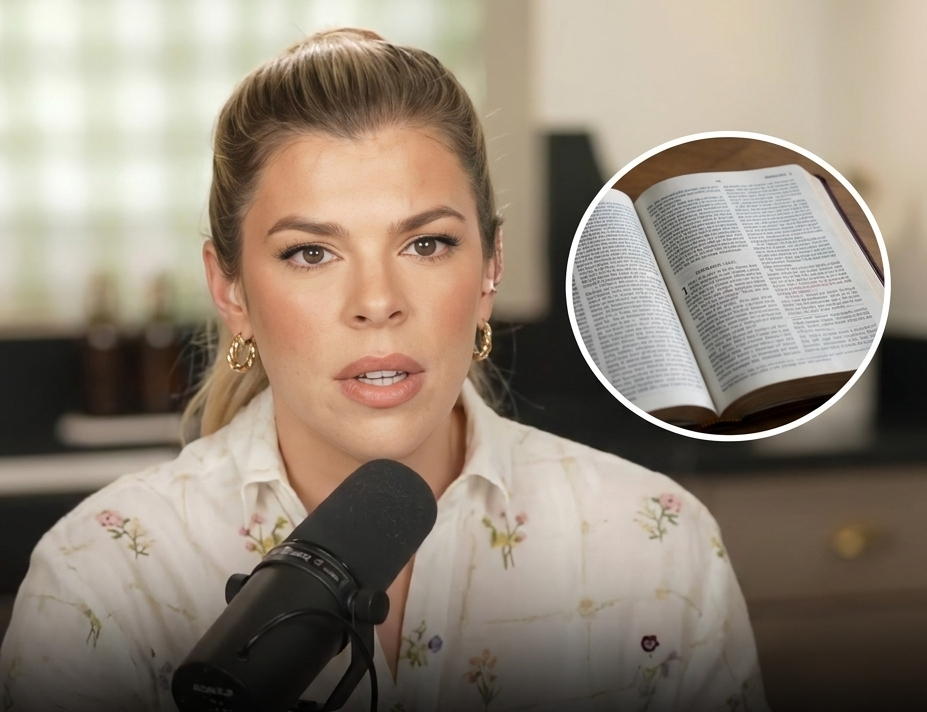
Allie Beth Stuckey is once again pressing a line that has become central to her public ministry: Scripture and LGBT affirmation cannot be reconciled. In recent commentary tied to Pride Month and broader debates over sexuality, the evangelical host framed the issue not as a matter of personal preference but of biblical authority and Christian obedience.
Her argument lands in a familiar but still fiercely contested place. Stuckey has maintained that Christians cannot label biblical teaching on sex and marriage as harsh or outdated simply because modern culture rejects it. At the center of her case is the claim that the Bible presents marriage as the covenant union of one man and one woman, with sexual intimacy reserved for that covenant alone.
The discussion matters because it reaches far beyond one influencer’s feed. It touches churches, families, ministries, schools, and the daily decisions of Christians trying to live faithfully in a culture that increasingly treats LGBT affirmation as a moral baseline. For Stuckey, the question is not whether Christians should be kind. It is whether kindness can be separated from truth.
Her latest remarks continue a pattern that has marked her recent public comments. Rather than introducing a new position, she has reinforced an older one: that any attempt to bless same-sex relationships while claiming fidelity to Scripture requires either ignoring or reinterpreting passages she views as clear. That puts her squarely in a broader evangelical conversation over biblical interpretation, sexual ethics, and the limits of cultural accommodation.
Scripture, Not Sentiment
Stuckey’s central claim is that Scripture itself settles the matter. She connects the biblical view of marriage to creation, to Jesus’ teaching on marriage in the Gospels, and to the New Testament’s picture of Christ and the church. In that framework, marriage is not merely a social arrangement or a private emotional bond. It is a theological signpost.
That approach reflects a long-standing conservative Christian reading of the Bible, especially in churches that treat the opening chapters of Genesis as foundational for sexuality and human identity. In that view, male and female are not cultural inventions. They belong to God’s design, and that design is not subject to revision by changing public opinion.
The dispute, then, is not only about identity language or public celebration. It is about whether Christians can affirm same-sex relationships and still claim to stand under the authority of Scripture. Stuckey and like-minded conservative voices answer no, arguing that affirmation would require a shift in doctrine rather than a difference in emphasis.
That is no small thing. For many believers, the issue reaches into the weekly life of the church, from preaching and counseling to membership standards and pastoral care. Across denominations, pastors continue wrestling with how to speak truthfully, compassionately, and consistently when congregants, children, and relatives ask where the church stands.
Why The Debate Keeps Returning
The current wave of commentary is tied in part to Pride Month, when cultural celebrations and corporate campaigns draw fresh attention to questions of sexuality and belonging. Stuckey’s recent framing has contrasted LGBT celebration with what she describes as God’s unchanging design for marriage and sexuality. The contrast reflects a deeper conviction: that public celebration of sexual identity can collide with Christian conviction about holiness.
Christian media coverage of her comments shows how durable this conflict remains. What surfaces again and again is the same theological fault line. Some Christians argue that affirming same-sex relationships can coexist with a high view of Scripture. Others insist that such affirmation already crosses a line, because it changes the moral meaning of the text.
Stuckey’s position belongs to the second camp, and she has presented it as a matter of faithfulness rather than temperament. In her telling, the Bible does not merely offer a few isolated verses on sexual behavior. It tells a unified story about creation, covenant, sin, redemption, and the body. Once that story is accepted, she argues, Christians cannot simply revise it to match cultural expectations.
Many churches have learned how difficult that can be in practice. Congregations often include people with deeply mixed experiences of faith, sexuality, and identity. Some have embraced traditional teaching with renewed clarity. Others have adopted more affirming approaches. Still others have tried to hold both convictions together and ended up in prolonged confusion.
The Church And The Pressure To Compromise
Stuckey’s comments also tap into a wider anxiety among evangelical and mainline Christians alike: the fear that biblical language will be softened until it loses its meaning. Her message insists that believers will face pressure to mute doctrine in order to avoid being dismissed as intolerant.
That pressure is not imaginary. Churches that maintain traditional teaching on marriage and sexuality often face criticism from outside the church and tension within it. Younger believers may ask whether historic doctrine can survive in a changing social order. Leaders may feel the strain of holding to convictions while caring for people who experience those convictions as rejection.
Stuckey has positioned her argument as a response to that cultural moment. She has attempted to draw a clear line between truth and hostility, arguing that Christians should not confuse compassion with endorsement. Every person bears God’s image, she has emphasized in this broader line of reasoning, and every person needs the grace and salvation found in Jesus Christ.
That theological emphasis places her comments in a familiar Christian pattern. The New Testament repeatedly joins truth and mercy, conviction and gentleness, warning believers against both harshness and compromise. Paul’s letters, especially, insist that the church must speak plainly about sin while extending the hope of repentance and forgiveness. The tension remains hard, but it is not new.
A Debate About Authority
What makes Stuckey’s remarks stand out is not novelty but clarity. She is not framing the issue as a dispute over tone alone. She is treating it as a question of authority. If Scripture speaks plainly on sexuality, then the church does not get to vote on the outcome.
That conviction places her in open disagreement with more affirming Christian perspectives that interpret the relevant passages differently or see them as addressing exploitative relationships rather than covenantal same-sex unions. The divide is not merely pastoral. It is hermeneutical. Different readings of the same texts produce different moral conclusions, and those conclusions shape how churches define discipleship.
For many conservative Christians, this is why the issue keeps coming back. Pride Month may sharpen the conversation, but the deeper dispute remains unresolved: whether cultural approval can coexist with biblical faithfulness when it comes to sex, marriage, and gender. Stuckey’s answer is no, and she has made that answer part of her public witness.
Her critics and allies alike know the stakes. The church’s credibility, in this view, does not come from matching the mood of the age. It comes from remaining anchored to the Word it claims to believe. And for Christians trying to navigate a moment of deep social change, that remains a demanding and clarifying test.
As the conversation continues, Stuckey’s message leaves believers with a question that is both old and newly urgent: whether the church will let culture define truth, or let God’s Word do what it has always claimed to do.