
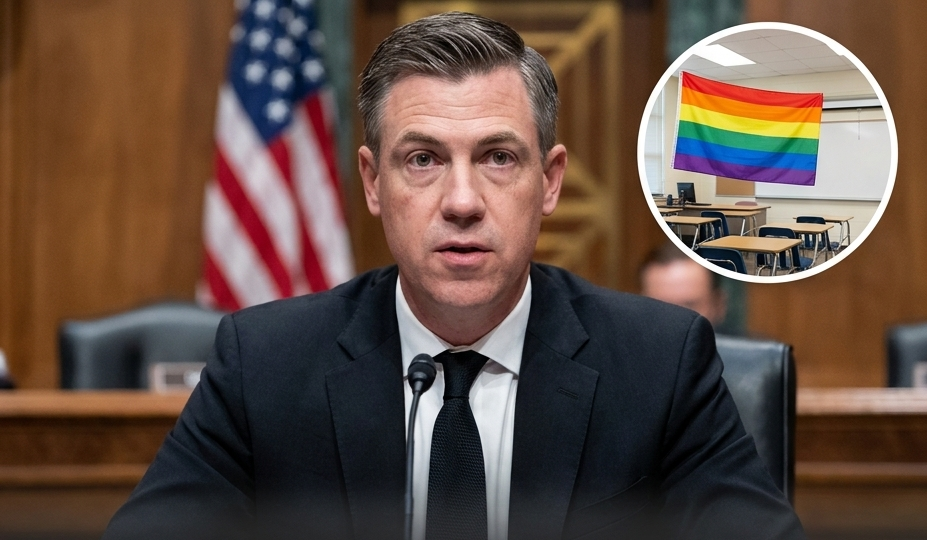
Sen. Jim Banks has drawn fresh attention to classroom controversy after opposing the display of gay pride flags in children’s classrooms, arguing that public schools should stay focused on academics rather than cultural symbolism. The Indiana Republican’s stance has landed in the middle of a wider fight over parental rights, school neutrality, and what young children should see each day in government-run classrooms.
The issue matters because it goes far beyond school décor. For many families, the flag debate now represents a deeper struggle over who shapes a child’s worldview first — parents, teachers, or the broader culture. And that is no small thing.
The Classroom Debate
Banks has aligned himself with a growing number of conservative lawmakers who argue that classrooms should not become places for ideological messaging, especially when the students are very young. His position reflects a view shared by many Christian parents who believe public schools should teach reading, math, science, and history without steering children into debates over sexuality or identity.
Supporters of that view see the classroom as a space that should remain open to all students, regardless of background, while avoiding symbols that some families view as political. They argue that a neutral room helps protect childhood innocence and preserves the role of parents in guiding moral formation. For those families, the concern is not simply about one flag. It is about the direction of public education itself.
The discussion has grown sharper because pride flags, in many districts, are treated not only as symbols of inclusion but also as public statements with clear cultural meaning. In schools with younger children, that meaning can be difficult to separate from larger questions about sex, gender, and identity. Banks’ criticism has resonated with parents who want schools to avoid those debates altogether.
Why Parents Are Paying Attention
Across the country, school policy fights have become more common as parents press for greater influence over classroom materials, displays, and instruction. That pressure has emerged in district meetings, statehouses, and school board races, often with questions about what belongs in classrooms and what belongs at home.
For Christian families, the dispute can carry an added weight. Many believe children should be formed first in the home and in the church, where faith, morality, and conscience can be taught within a family’s own beliefs. Scripture places strong emphasis on the responsibility of parents to instruct children, as seen in Deuteronomy 6:7, which calls for diligent teaching in daily life.
That passage has long shaped the thinking of many believers who see education as a partnership, not a takeover. Schools have a role, but not an unlimited one. When that boundary blurs, parents often react quickly.
Banks’ comments have tapped into exactly that anxiety. His message has found an audience among families who believe children are being exposed too early to controversial cultural issues. In their view, a classroom should foster learning, discipline, and respect — not become a stage for adult disputes.
What Schools Are Trying To Do
School leaders and teachers who support pride flags usually frame them as symbols of welcome, not political advocacy. In that view, such displays are meant to make LGBTQ students feel safe and seen in environments where they may otherwise face isolation or teasing. Administrators often describe these decisions as part of broader efforts to create supportive schools.
That approach has created friction with families who do not accept the idea that a welcoming school must also display symbols tied to contested moral questions. The result is a familiar public-school dilemma: how to show care for one group of students without alienating another. The line is not easy to draw.
Some districts have tried to limit the confusion by setting clearer rules for what may appear in classrooms. Others leave room for individual teachers or schools to decide, which often leads to uneven enforcement and renewed conflict. Where those policies lack clarity, disputes can quickly spread from one room to an entire district.
Banks’ stance adds political weight to those local battles. When a sitting senator speaks to a national concern, parents often hear their own frustrations echoed in Washington. That does not settle the matter, but it does give the issue a louder platform.
A Wider Cultural Flashpoint
The classroom flag debate is taking place in a nation already divided over education, gender policy, and the proper role of parents in public life. School boards have become ground zero for fights that once stayed on the margins of civic discussion. What once seemed like a local disagreement now carries national symbolism.
For Christian observers, the issue also touches a deeper theological tension: how to speak truth with conviction while treating all people with dignity. Many churches hold that every person bears the image of God, a conviction drawn from Genesis 1:27, while also insisting that public institutions should not pressure children toward messages their families reject. Both ideas sit side by side in the Christian moral imagination.
That balance is one reason the issue remains so charged. The debate is not only about flags. It is about authority, conscience, and the limits of public institutions. It is also about how much room remains for parents to form children according to their faith in a culture that often pushes in a different direction.
Banks’ comments have therefore become part of a larger American conversation that reaches well beyond one senator or one school district. The question behind the flag is whether public classrooms should function as neutral educational spaces or as places where cultural causes are increasingly visible.
What Comes Next
The controversy is unlikely to fade soon. Similar disputes keep surfacing in school districts across the country, and lawmakers from both parties are watching closely as parents continue to demand clarity. In many places, the issue will likely be settled one classroom, one board meeting, and one policy decision at a time.
For Christian families, the fight is likely to continue as well, because it touches convictions about childhood, family authority, and the role of schools in public life. The lesson for many believers is simple: if a child’s classroom is where the culture speaks loudest, then parents will keep asking who gets the first word.
That question will not disappear anytime soon, but it may yet push schools toward greater restraint and families toward a stronger resolve to teach their children well at home.