
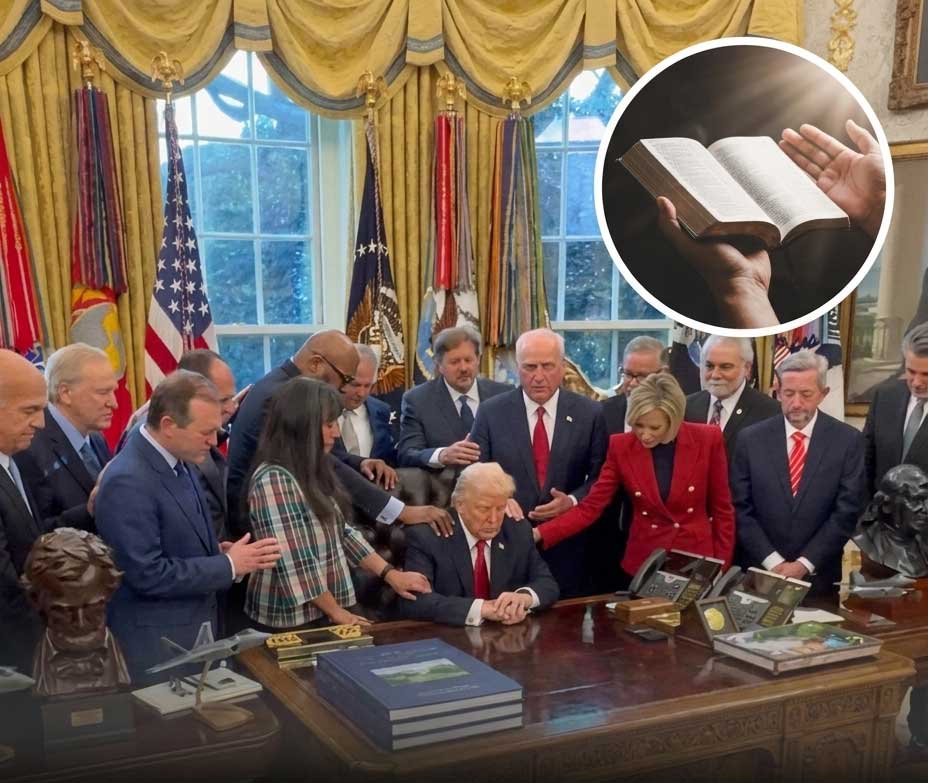
WASHINGTON D.C. — As American forces continue military operations against Iran under what the administration has named Operation Epic Fury, President Donald Trump opened the doors of the Oval Office to more than twenty of the nation’s most prominent evangelical Christian leaders — and asked them to pray.
The gathering, which took place on March 5, 2026, was organized by Pastor Paula White-Cain, head of the White House Faith Office and one of the president’s longest-serving spiritual advisers. Video released by the White House and shared widely across social media showed the president seated behind the Resolute Desk while pastors and faith leaders stood around him, placing their hands on his shoulders and arms in prayer.
Who Was in the Room
The gathering brought together a significant cross-section of America’s evangelical leadership. Among those identified in attendance were:
Pastor Greg Laurie, founder of Harvest Christian Fellowship and one of the nation’s most recognized megachurch pastors. Pastor Jentezen Franklin, senior pastor of Free Chapel in Gainesville, Georgia. Robert Jeffress, senior pastor of First Baptist Church in Dallas, Texas. Ralph Reed, founder of the Faith and Freedom Coalition. Gary Bauer of the Family Research Council. Samuel Rodriguez, president of the National Hispanic Christian Leadership Conference. Johnnie Moore, prominent evangelical leader and former executive chairman of the Gaza Humanitarian Foundation. David Barton, Christian historian and political activist. Pastor Tom Mullins led the spoken portion of the prayer.
What Was Prayed
Pastor Mullins led the room in an audible prayer that was captured on video and heard by millions. He asked for divine wisdom to guide the president’s decisions, protection over American troops serving abroad, and a return to national unity under God.
“We pray for wisdom from heaven to guide his heart and mind, and that you will guide him in these challenging times we’re facing today,” Mullins prayed. “Father, we pray you’ll continue to give our president the strength that he needs to lead our great nation — as we come back to one nation under God, indivisible, with liberty and justice for all. We pray your heavenly blessing upon him, in Jesus’ name.”
What Faith Leaders Said Afterward
Reverend Samuel Rodriguez described the moment as one of the most significant he had experienced in public life.
“Leadership at the highest level ultimately requires dependence upon God, wisdom beyond human understanding, and the covering of prayer,” Rodriguez wrote on social media following the meeting. “Even in the midst of global conflict and immense responsibility, the Oval Office was opened for prayer. This moment served as a reminder that faith still has a place in the highest rooms of leadership — and that prayer remains one of the most powerful acts we can offer on behalf of our nation.”
Ralph Reed of the Faith and Freedom Coalition used his public statement to connect the prayer gathering directly to the military operation underway. “I am grateful to President Trump for his courageous decision to strike the terrorist regime in Iran,” Reed wrote. “I am honored to pray for him and our armed forces at the White House. May God grant victory and freedom for the Iranian people.”
Pastor Jentezen Franklin, who also attended, posted on social media calling it an “incredible day” and describing the prayer circle as a meaningful act of national intercession at a consequential moment in history.
The Broader Context
The Oval Office prayer gathering is not an isolated event. Faith-based meetings with evangelical leaders have become a regular feature of the Trump presidency across both of his terms in office. The White House Faith Office, led by White-Cain, has served as the coordinating body for these engagements, facilitating ongoing relationships between the administration and America’s conservative Christian community.
The meeting took place against a backdrop of significant geopolitical tension. Operation Epic Fury, the administration’s military campaign targeting Iranian regime infrastructure and ballistic and nuclear missile capabilities, has been the defining foreign policy event of the early months of 2026. President Trump has stated publicly that there will be “no deal with Iran except unconditional surrender,” signaling an administration posture of maximum pressure.
Robert Jeffress, speaking to reporters following the gathering, was direct about how he frames the conflict in theological terms. “This is not a war against Islam or against Muslims,” Jeffress said. “It is a spiritual war between good and evil, between the kingdom of God and the kingdom of Satan.”
Voices of Support and Criticism
The prayer gathering drew strong support from within the evangelical community. Jentezen Franklin’s social media post expressing gratitude for the moment was widely shared among Christian audiences. Samuel Rodriguez’s account of the meeting resonated deeply with believers who see prayer as inseparable from national leadership.
However, the event also drew criticism from other corners of the Christian world. Pope Leo XIV, addressing tens of thousands in St. Peter’s Square on Palm Sunday, called the Iran conflict “atrocious” and stated that the name of Jesus should never be invoked to propagate war. Some progressive Christian leaders expressed concern that religious language was being used primarily as a political tool rather than a genuine expression of faith.
A Nation at a Crossroads
What is clear is that the image of twenty Christian leaders standing around the President of the United States in the Oval Office — hands laid on his shoulders, heads bowed, asking God for wisdom, protection, and peace — has become one of the defining images of this moment in American history.
Whether one views it as a powerful act of national intercession or a complicated intersection of faith and geopolitics, the moment speaks to something that cannot be easily dismissed: at one of the most consequential hours of his presidency, Donald Trump called the Church into the room.
And the Church came.